

Registered nurses lead every healthcare job on this list with 180,800 projected openings a year from 2025 to 2035, while the typical job in the top 25 has 12,500. An aging population, the steady move of care into homes and outpatient clinics, and the constant need to replace workers who retire or switch careers drive most of the ranking. Growth alone does not set the order: several jobs near the top are growing slowly but lose many workers each year.
The measure is projected annual average openings from the Bureau of Labor Statistics (BLS) Employment Projections 2025–35, Table 1.2, released August 27, 2026, the latest edition. Openings count both new jobs and jobs left open when workers leave an occupation, averaged over the 2025 to 2035 decade, so the title's 2035 matches the end year of the projections. Of 62 healthcare jobs that passed every data rule, the 25 shown here sit above a natural break: the 26th job's openings are 19.0% lower than the 25th's. Employment figures are for 2025 and projected 2035, and pay is the 2025 median.
What the data shows:
- 🩺 Registered nurses have 180,800 openings a year, 129,000 more than the second-place job, licensed practical nurses.
- 🚀 Nurse practitioners are the fastest-growing job on the list at 41.0%, adding 137,800 jobs from 2025 to 2035.
- 🧪 Medical laboratory technologists rank fifth with 20,800 openings a year despite growth of just 2.7%, tied for the lowest on the list.
- 💵 Dentists earn the highest median wage on the list at $170,950, and dietetic technicians the lowest at $37,640.
- 📊 The median job in the top 25 has 12,500 openings a year, compared with 2,400 for all 62 qualifying healthcare jobs.
| # | Job | Annual average openings, 2025–35 | Employment, 2025 | Employment, 2035 | Change, 2025–35 | Pct change, 2025–35 | Median wage, 2025 |
|---|---|---|---|---|---|---|---|
| 1 | Registered Nurses | 180,800 | 3,465,400 | 3,660,100 | 194,700 | 5.6% | $97,550 |
| 2 | Licensed Practical Nurses | 51,800 | 666,900 | 686,700 | 19,700 | 3.0% | $64,400 |
| 3 | Pharmacy Technicians | 44,700 | 471,200 | 501,300 | 30,100 | 6.4% | $45,750 |
| 4 | Nurse Practitioners | 29,400 | 336,300 | 474,100 | 137,800 | 41.0% | $132,300 |
| 5 | Medical Laboratory Technologists | 20,800 | 343,000 | 352,400 | 9,400 | 2.7% | $62,930 |
| 6 | Psychiatric Technicians | 17,000 | 161,500 | 197,500 | 36,000 | 22.3% | $45,130 |
| 7 | Dental Hygienists | 15,000 | 225,300 | 243,200 | 17,900 | 8.0% | $98,100 |
| 8 | Medical Records Specialists | 14,000 | 200,700 | 216,300 | 15,600 | 7.8% | $51,140 |
| 9 | Emergency Medical Technicians | 13,800 | 181,900 | 192,500 | 10,600 | 5.8% | $44,470 |
| 10 | Physical Therapists | 13,400 | 283,700 | 317,600 | 33,800 | 11.9% | $102,760 |
| 11 | Veterinary Technicians | 13,400 | 131,400 | 143,800 | 12,300 | 9.4% | $47,380 |
| 12 | Radiologic Technologists | 13,000 | 234,200 | 246,000 | 11,800 | 5.0% | $80,110 |
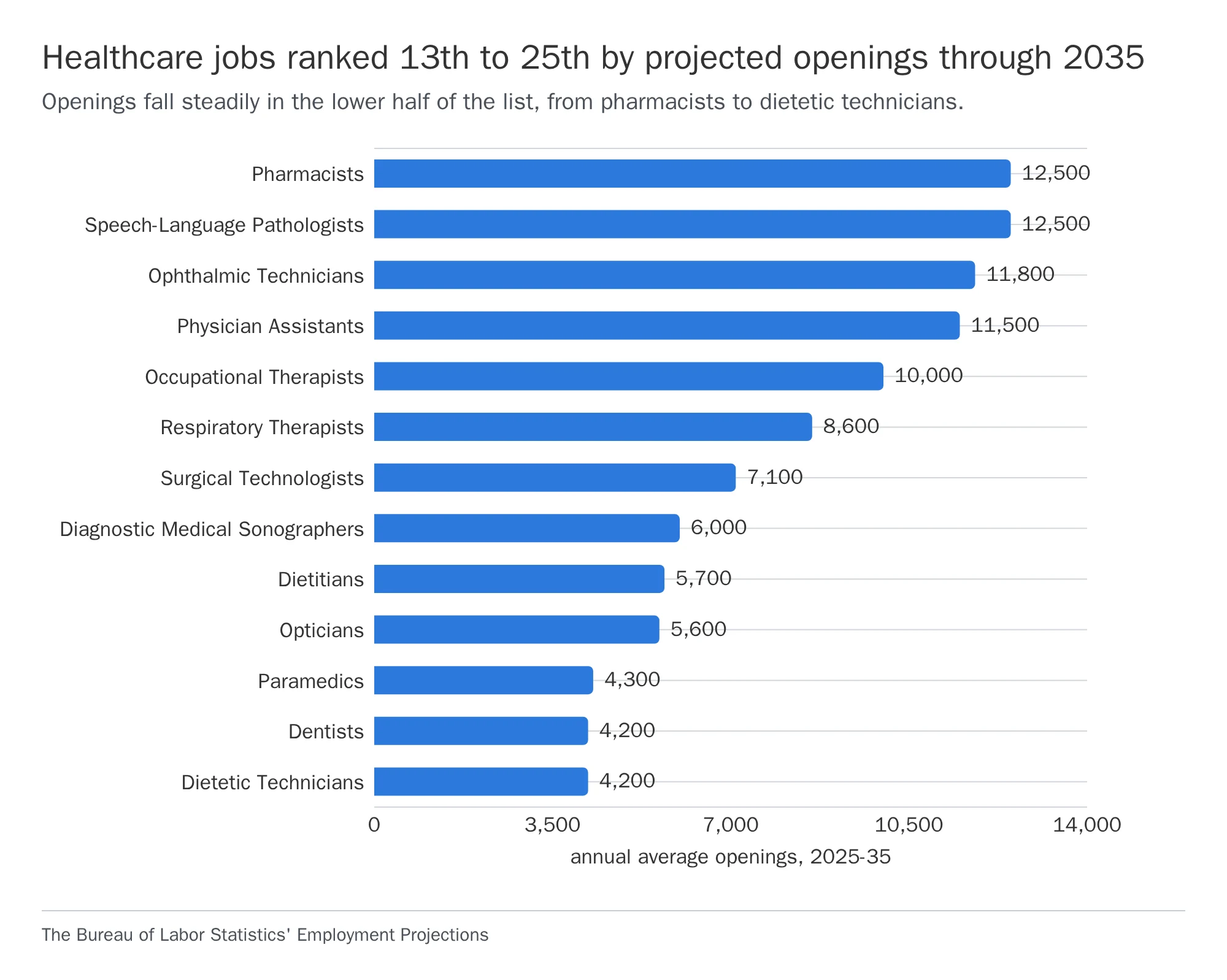
| 13 | Pharmacists | 12,500 | 325,200 | 342,300 | 17,100 | 5.2% | $140,910 |
| 14 | Speech-Language Pathologists | 12,500 | 193,400 | 225,500 | 32,100 | 16.6% | $97,870 |
| 15 | Ophthalmic Technicians | 11,800 | 72,500 | 88,000 | 15,500 | 21.4% | $45,570 |
| 16 | Physician Assistants | 11,500 | 168,900 | 204,600 | 35,700 | 21.1% | $135,880 |
| 17 | Occupational Therapists | 10,000 | 169,600 | 194,800 | 25,200 | 14.8% | $100,330 |
| 18 | Respiratory Therapists | 8,600 | 142,000 | 154,200 | 12,100 | 8.5% | $82,280 |
| 19 | Surgical Technologists | 7,100 | 118,400 | 124,300 | 5,900 | 5.0% | $64,650 |
| 20 | Diagnostic Medical Sonographers | 6,000 | 92,200 | 105,100 | 12,900 | 13.9% | $96,590 |
| 21 | Dietitians | 5,700 | 86,300 | 93,000 | 6,700 | 7.7% | $76,400 |
| 22 | Opticians | 5,600 | 74,300 | 77,400 | 3,100 | 4.2% | $47,260 |
| 23 | Paramedics | 4,300 | 102,200 | 108,000 | 5,800 | 5.7% | $60,600 |
| 24 | Dentists | 4,200 | 141,900 | 150,000 | 8,100 | 5.7% | $170,950 |
| 25 | Dietetic Technicians | 4,200 | 32,100 | 32,900 | 900 | 2.7% | $37,640 |
Source: U.S. Bureau of Labor Statistics, Employment Projections 2025–35, Table 1.2. Openings are annual averages over 2025 to 2035; median wage is for 2025.

Why Healthcare Openings Stay High
Older Americans need more care, and that demand spreads across almost every job on this list. The Census Bureau's 2017 projections found that by 2034 there would be 77.0 million people 65 and older, compared with 76.5 million children, the first such crossover in U.S. history. BLS ties its healthcare outlook to the same trend, saying the aging population and chronic disease will raise demand for diagnosis and treatment through 2035.
Healthcare is the biggest source of new jobs in the economy. BLS projects that private healthcare and social assistance will add more than 2.2 million jobs from 2025 to 2035, about 37.0% of all new jobs. Healthcare support jobs are projected to grow 13.3% and healthcare practitioner and technical jobs 8.0%, the two fastest-growing of all 22 major job groups.
Much of that growth is happening outside hospitals. In the same release, BLS projects that services for the elderly and people with disabilities will add 625,400 jobs, the most of any detailed industry, and it credits rising demand for home-based care. Offices of physical, occupational and speech therapists are projected to grow 25.4%, among the 10 fastest-growing industries.
Turnover matters as much as growth. BLS builds projected openings by adding new jobs to the number of workers expected to leave an occupation for good, through retirement or a move to another line of work, then dividing by 10. That is why a large, slow-growing job can outrank a small, fast-growing one: a big workforce produces many departures every year.
1. Registered Nurses: 180,800 Openings a Year
Registered nurses have the most openings of any healthcare job, at 180,800 a year from 2025 to 2035. The workforce is huge, with 3,465,400 jobs in 2025, and BLS projects it will add 194,700 jobs over the decade, growth of 5.6%. The median wage was $97,550 in 2025. BLS says many of those openings will come from replacing nurses who move to other jobs or leave the labor force, such as to retire.
Demand comes from age and setting. BLS expects more need for nurses because older people typically have more medical problems, with growth in hospitals, outpatient centers that offer same-day chemotherapy, rehabilitation and surgery, and home health care. Those three settings mean nursing openings are spread widely, not concentrated in one kind of employer.
Exits keep the count high. The National Council of State Boards of Nursing's 2024 National Nursing Workforce Study, released April 17, 2025, surveyed 800,000 nurses and found that more than 138,000 nurses had left the workforce since 2022, citing stress, burnout and retirement. The same study found that 39.9% of RNs reported an intent to leave or retire within five years. Among nurses planning to leave, about 41.5% named stress and burnout as the root cause. These are stated intentions, not confirmed exits, so they show pressure on the workforce rather than a precise count of future openings.
Getting into the field can be harder than the openings suggest. Nursing schools turned away 80,162 qualified applications in 2024, according to the American Association of Colleges of Nursing, which counts applications rather than people. That limit shapes who fills the openings, not how many there are.
2. Licensed Practical Nurses: 51,800 Openings a Year
Licensed practical nurses rank second with 51,800 openings a year from 2025 to 2035. Employment was 666,900 in 2025, and BLS projects growth of 3.0%, or 19,700 jobs, over the decade. The median wage was $64,400 in 2025. With growth that modest, most of these openings come from replacing workers who leave.
LPNs are a different job from registered nurses, with a shorter training path and a narrower scope. BLS says LPNs will be needed in residential care and home health to care for older patients, and nursing and residential care facilities employ 37% of them. That ties LPN demand closely to long-term care for an aging population.
Planned exits run even higher than for RNs. NCSBN's April 17, 2025 release of its 2024 study found that 41.3% of LPNs and licensed vocational nurses reported an intent to leave the workforce or retire within five years. Those intentions help explain why replacement needs dominate this job's openings, though not every nurse who plans to leave will do so.
3. Pharmacy Technicians: 44,700 Openings a Year
Pharmacy technicians rank third with 44,700 openings a year from 2025 to 2035. The job had 471,200 workers in 2025, and BLS projects it will add 30,100 jobs, growth of 6.4%. The median wage was $45,750 in 2025, among the lower wages in the top 25.
High turnover is the clearest driver. ASHP sent a November 2021 survey to 1,952 hospital and health-system pharmacy leaders. A majority reported turnover of at least 21% in 2021, and nearly 1 in 10 lost 41% or more of their technicians. In a companion survey of more than 5,000 technicians, salary was the reason most often named for leaving, and three-quarters said higher pay is the best way to keep technicians. At ASHP's Midyear meeting in December 2024, Diana Broome of Harris Health System estimated that technician turnover exceeds 20% nationwide, with vacancy rates as high as 40%. She put the cost at $25,000 to $35,000 per technician lost.
Employers have responded with pay. In June 2022, Walmart raised average pay for its pharmacy technicians to more than $20 an hour, covering more than 36,000 technicians amid what Axios called a nationwide shortage. The ASHP surveys covered hospitals and health systems, so they do not measure turnover at retail drugstores, where most technicians work.
4. Nurse Practitioners: 29,400 Openings a Year
Nurse practitioners rank fourth with 29,400 openings a year from 2025 to 2035. BLS projects employment will grow 41.0%, from 336,300 jobs in 2025 to 474,100 in 2035, the fastest growth of any detailed occupation in the economy. The median wage was $132,300 in 2025. Unlike the three jobs above, growth rather than replacement drives a large share of these openings.
BLS links that growth to the central role nurse practitioners play in collaborative, team-based models of care. State law is a likely contributor. As of 2025, 27 states, Washington, D.C., and two U.S. territories had adopted full practice authority, which lets nurse practitioners diagnose, treat and prescribe under the state nursing board without a required physician agreement. In 11 of those states, new NPs must first work under a practice agreement for a set period.
Fast growth does not mean the most openings. Nurse practitioners still trail licensed practical nurses and pharmacy technicians because their workforce is smaller and fewer workers leave each year. Nurse practitioners must already be registered nurses with graduate training, so this is an advancement path more than an entry-level one.
5. Medical Laboratory Technologists: 20,800 Openings a Year
Medical laboratory technologists rank fifth with 20,800 openings a year from 2025 to 2035. BLS projects growth of just 2.7%, or 9,400 jobs, from a 2025 base of 343,000. The median wage was $62,930 in 2025. BLS profiles this work under clinical laboratory technologists and technicians, who run the tests doctors use to diagnose and treat disease.
Retirements explain much of the gap between slow growth and strong openings. The American Society for Clinical Pathology's 2024 Vacancy Survey found that retirement rates continue to rise, with 10 of 17 lab departments reporting increases. It also found vacancy rates below 2022 levels but still above pre-pandemic levels. The survey reflects the labs that answered it, so it shows the direction of change more reliably than the size of national openings.
The Other 20: What Drives Their Openings
- Psychiatric Technicians (17,000 a year): BLS ranks them among the 10 fastest-growing jobs at 22.3%, citing rising demand to treat behavioral health disorders.
- Emergency Medical Technicians (13,800 a year): The 2024 American Ambulance Association and Newton 360 turnover study, covering nearly 20,000 EMS workers, found turnover of 20% to 30% a year among EMTs and paramedics.
- Physical Therapists (13,400 a year): BLS projects offices of physical, occupational and speech therapists to grow 25.4%, adding 130,600 jobs.
- Speech-Language Pathologists (12,500 a year): BLS expects more strokes and dementia in an aging population to raise demand for speech and language treatment.
- Ophthalmic Technicians (11,800 a year): BLS lists them among the 10 fastest-growing jobs at 21.4%, driven by aging and chronic disease.
- Occupational Therapists (10,000 a year): The same fast growth in therapist offices reaches this job, which BLS projects to add 25,200 jobs.
- Paramedics (4,300 a year): The American Ambulance Association says highly trained paramedics are being hired by hospitals to offset the nursing shortage, adding to EMS turnover.
No documented cause was found for Dental Hygienists, Medical Records Specialists, Veterinary Technicians, Radiologic Technologists, Pharmacists, Physician Assistants, Respiratory Therapists, Surgical Technologists, Diagnostic Medical Sonographers, Dietitians, Opticians, Dentists and Dietetic Technicians.
Just Missed the List
Cardiovascular technologists rank 26th with 3,400 openings a year from 2025 to 2035. That is 800 fewer than dietetic technicians and dentists, which tie at 4,200 for the last spots. The gap of 23.5% is the largest step between neighboring jobs anywhere from 5th place down, which is why the list stops at 25. The smallest of all 62 qualifying jobs is podiatrists, with 200 openings a year.
What's Not in the Data
These are projections, not guarantees. BLS calls them a scenario under specific assumptions, not a forecast, and actual numbers will differ if those assumptions do not hold.
Openings are not job offers. They estimate how many people will need to enter each occupation, not how many postings will appear or how many applicants will be hired.
Replacement openings count workers who leave an occupation entirely. A nurse who switches hospitals but stays a nurse does not create an opening in this measure, so turnover between employers runs far higher than these figures.
The list covers practitioner and technician jobs only. Aide and assistant jobs, such as home health aides, nursing assistants and medical assistants, are not among the 62 qualifying jobs, even though some of them have more openings than most jobs here.
FAQs
Which healthcare job will have the most openings through 2035?
Registered nurses. BLS projects 180,800 openings a year for registered nurses from 2025 to 2035, far more than any other healthcare job on the list. Licensed practical nurses rank second with 51,800 a year.
Which healthcare job is growing the fastest?
Nurse practitioners. Employment is projected to grow 41.0% from 2025 to 2035, adding 137,800 jobs. That is the fastest growth of any detailed occupation in the BLS projections.
How many openings will licensed practical nurses have each year?
51,800 a year. BLS projects that average for licensed practical nurses from 2025 to 2035, with employment growing 3.0%. Most openings come from replacing workers who leave.
Do most healthcare openings come from new jobs?
No. BLS openings combine new jobs with workers who permanently leave an occupation. For registered nurses, BLS says many of the 180,800 yearly openings from 2025 to 2035 will come from replacing nurses who retire or change careers.
Which healthcare job on the list pays the most?
Dentists, at $170,950. That was the 2025 median wage. Pharmacists follow at $140,910, and dentists have 4,200 openings a year from 2025 to 2035.
What is the outlook for medical laboratory technologists?
20,800 openings a year. BLS projects that average from 2025 to 2035 even though employment grows only 2.7%. Rising retirements in lab departments help keep openings high.
Are projected openings the same as job vacancies?
No. Projected openings estimate how many workers must enter an occupation each year over 2025 to 2035. They do not count job postings, and they leave out workers who change employers within the same job.
How This List Was Built
The ranking uses projected annual average openings from the BLS Employment Projections 2025–35, Table 1.2, released August 27, 2026. Openings equal the projected change in employment plus workers expected to leave each occupation for good, averaged over 2025 to 2035. Employment is shown for 2025 and projected 2035, and pay is the 2025 median wage. Each job had to keep the same occupation code in both years, meet a minimum size and pass national and series consistency checks; 62 healthcare jobs qualified, and no rows were excluded by those rules. The list stops at 25 because the next job's openings drop 19.0%, far more than the typical 5.0% step between jobs ranked 5th through 25th.