

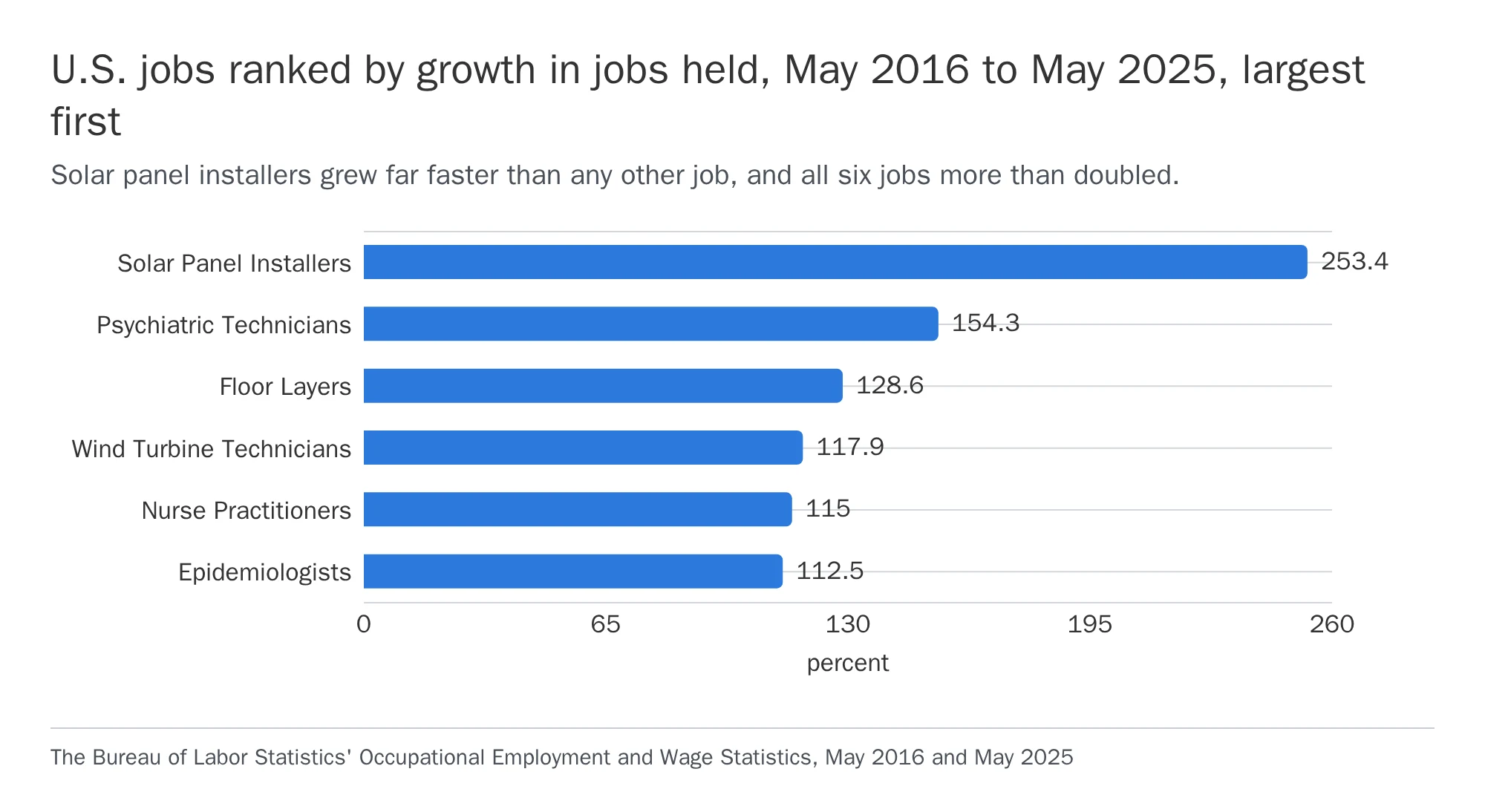
Solar panel installers are the fastest-growing U.S. job, with 253.4% more jobs in May 2025 than in May 2016, while the typical job on the list shrank by 1.6%. Clean-energy tax credits, rising demand for mental health and primary care, and federal money for public health drive most of the ranking. Every job in the top six at least doubled over those nine years.
This ranking compares the number of jobs held in each occupation in May 2016 and May 2025, using the Bureau of Labor Statistics' Occupational Employment and Wage Statistics (OEWS). May 2025 is the latest month BLS has published, so this 2026 article rests on those figures. A job had to have at least 1,000 workers nationally and the same job code in both years to qualify, and 625 jobs did.
What the data shows:
- ☀️ Solar panel installers grew 253.4%, from 8,870 jobs to 31,350, which puts them 99.1 points ahead of the No. 2 job.
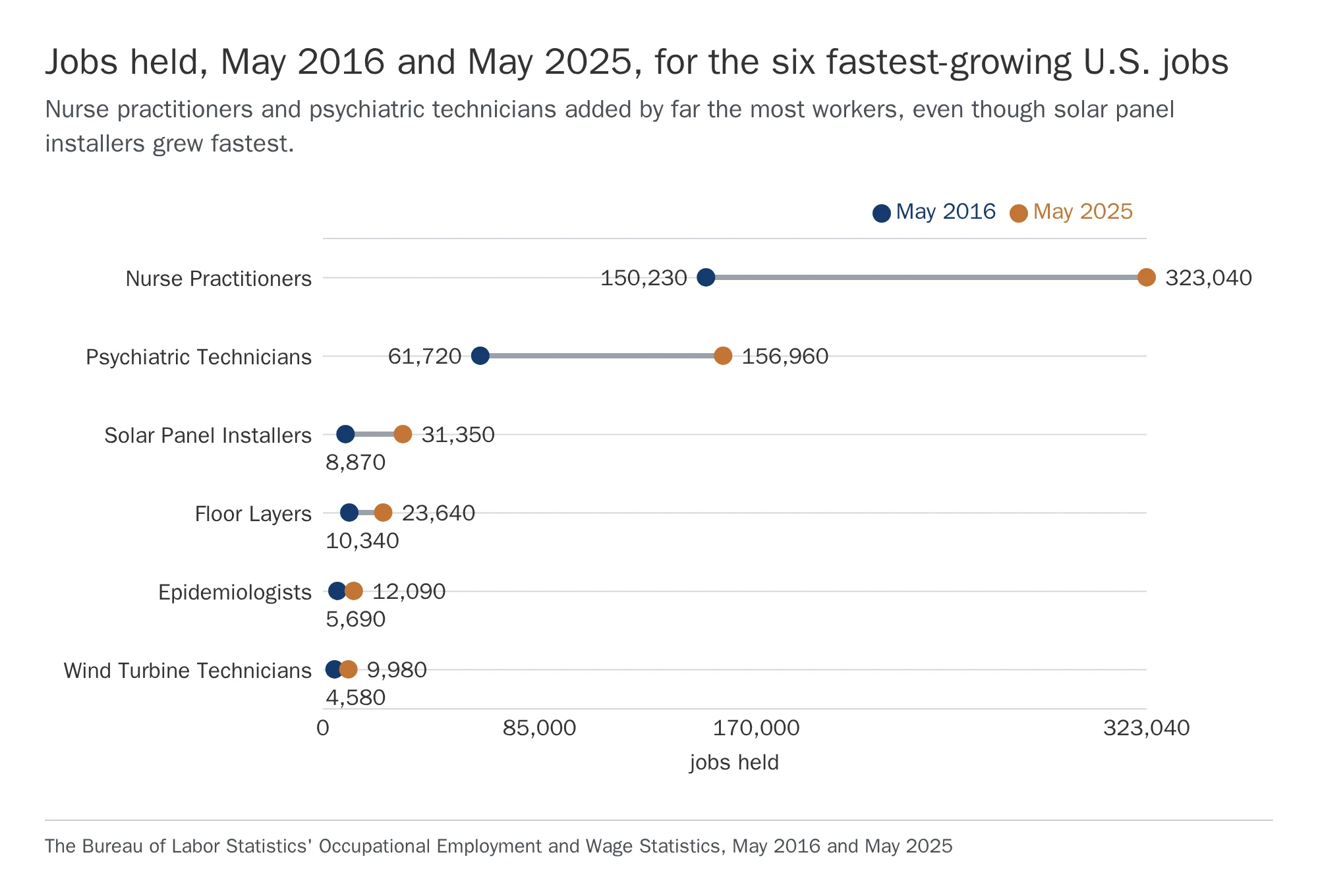
- 🧠 Psychiatric technicians added 95,240 jobs, the second-largest gain in the table.
- 🩺 Nurse practitioners added 172,810 jobs, more than any other job in the top six.
- 📉 Of the 625 jobs that qualified, 328 lost workers between May 2016 and May 2025.
- 🎓 Two of the six jobs, nurse practitioners and epidemiologists, typically need a master's degree, the education level with the highest median change (26.4%).
| Rank | Job | Jobs (May 2016) | Jobs (May 2025) | Change | Jobs added | Median pay (May 2025) |
|---|---|---|---|---|---|---|
| 1 | Solar Panel Installers | 8,870 | 31,350 | 253.4% | 22,480 | $53,140 |
| 2 | Psychiatric Technicians | 61,720 | 156,960 | 154.3% | 95,240 | $45,130 |
| 3 | Floor Layers | 10,340 | 23,640 | 128.6% | 13,300 | $56,460 |
| 4 | Wind Turbine Technicians | 4,580 | 9,980 | 117.9% | 5,400 | $64,120 |
| 5 | Nurse Practitioners | 150,230 | 323,040 | 115.0% | 172,810 | $132,300 |
| 6 | Epidemiologists | 5,690 | 12,090 | 112.5% | 6,400 | $87,220 |
Source: U.S. Bureau of Labor Statistics, Occupational Employment and Wage Statistics, May 2016 and May 2025.
Why These Jobs Grew So Fast
Three forces run through the list: tax credits for clean power, more demand for health care, and public money for health departments. Two of the six jobs build or fix power equipment, and three work in health care or public health. The sixth, floor layers, rode a shift in what Americans put on their floors.
Federal tax credits set the pace for solar and wind work. The Energy Information Administration reports that wind builders rushed to finish projects in 2020 to qualify for the full tax credit, and Congress extended the credit at 60% of its full value through December 31, 2021. For solar, the industry's trade group called 2023 a record-setting first full year of the Inflation Reduction Act, with 32.4 gigawatts added.
Health care demand is the second force. BLS expects the aging population and more chronic disease to drive growth in private health care, which it projects will add more than 2.2 million jobs from 2025 to 2035, according to its 2025–35 projections release. That same release names nurse practitioners as the fastest-growing detailed job of the coming decade, at 41.0%.
Small jobs can post huge percentages. Wind turbine technicians added 5,400 jobs to rank fourth, while nurse practitioners added 172,810 to rank fifth. For a reader weighing careers, the jobs-added column says more about how many openings exist than the percentage does.
1. Solar Panel Installers: Up 253.4%
Solar panel installers held 31,350 jobs in May 2025, up from 8,870 in May 2016. That is a gain of 22,480 jobs. BLS defines these workers as people who assemble, set up, and maintain rooftop or other systems that turn sunlight into power. Their median pay was $53,140 in May 2025, slightly above the $50,980 median for all jobs.
Most of the growth came late in the period. The job barely moved from May 2016 to May 2018, then jumped from 11,490 jobs in May 2020 to 27,760 in May 2022. After a dip to 24,510 in May 2023, it climbed again to its May 2025 peak.
The late surge fits the Inflation Reduction Act, signed in August 2022. The Solar Energy Industries Association reported that the U.S. added a record 32.4 gigawatts of solar in 2023, a 51% increase from 2022. That record lines up with the job's rise from May 2023 to May 2025. The same SEIA report says the previous record was set in 2021, which is a likely contributor to the jump into May 2022.
No documented cause explains the May 2023 dip. The regional data covers only California, where the job grew 76%, well below the national rate. BLS now projects the job to grow 36.5% from 2025 to 2035, among the five fastest, though it expects solar and wind installers together to add fewer than 15,000 jobs.
2. Psychiatric Technicians: Up 154.3%
Psychiatric technicians held 156,960 jobs in May 2025, up from 61,720 in May 2016. The gain of 95,240 jobs is the second-largest in the table. These workers care for people with mental or emotional conditions or developmental disabilities, monitor patients and give medicines under a doctor's or nurse's direction. Their median pay was $45,130 in May 2025, the lowest in the table.
The job grew every single year, and the pace picked up after May 2022. It added about 56,000 jobs between May 2022 and May 2025 alone, going from 100,950 to 156,960. Growth reached every region, from 99.7% in the South to 207.4% in the Midwest.
BLS ties the growth to rising need. It says psychiatric technicians "will increasingly be needed to treat the growing number of people who have mental illness or substance use disorders." BLS also says organizations "increasingly rely on psychiatric technicians" instead of psychiatric aides, which points to employers shifting work from one job to the other.
Where these workers now sit says a lot. Offices of mental health practitioners other than physicians employ 15% of psychiatric technicians, more than private psychiatric hospitals at 14%. BLS found that offices of mental health practitioners and outpatient centers had especially strong growth over the decade before 2022.
Behavior therapy for autism is a likely contributor, though BLS has not said so. BLS does not publish a separate code for behavior technicians, and Arizona's state-run AZ Job Connection site lists Registered Behavior Technician training under the psychiatric technician code, 29-2053. The Behavior Analyst Certification Board counted 246,109 Registered Behavior Technicians at the end of 2025, up from 130,273 at the end of 2022. That board count covers certificants worldwide and includes part-time workers, so it cannot be matched job for job with the BLS figure.
Hospital expansion adds a smaller push. Acadia Healthcare, which calls itself the largest stand-alone behavioral healthcare company in the U.S., reported adding 302 beds to existing facilities in 2023, when it ran about 11,200 beds in all. One company's beds reach only part of a job this size.
3. Floor Layers: Up 128.6%
Floor layers held 23,640 jobs in May 2025, up from 10,340 in May 2016. BLS's full name for the job is floor layers, except carpet, wood, and hard tiles. O*NET describes the work as applying blocks, strips, or sheets of cushioning or decorative coverings to floors, with job titles such as vinyl installer. Their median pay was $56,460 in May 2025.
The job grew steadily to a peak of 25,150 in May 2023. It then slipped to 24,850 in May 2024 and 23,640 in May 2025. California, the only state in the regional data, grew 108.2%.
The rise of luxury vinyl flooring is a likely contributor. The Freedonia Group, a market research firm that sizes the luxury vinyl tile industry at $12.4 billion, reports that demand for luxury vinyl tile rose 28% per year from 2012 to 2022. Its share of the flooring market grew from 4% to 31% over that stretch, and Freedonia projected it would pass carpet in 2024. Those are volume figures for the product, not counts of installers, so they show where the work shifted rather than how many people did it.
No documented cause explains the drop after May 2023. The vinyl trend fits the growth years but not the decline.
4. Wind Turbine Technicians: Up 117.9%
Wind turbine technicians held 9,980 jobs in May 2025, up from 4,580 in May 2016. The gain of 5,400 jobs is the smallest in the table. These workers inspect, maintain and repair wind turbines. Their median pay was $64,120 in May 2025.
Nearly all the growth came in one jump. The job went from 5,860 jobs in May 2020 to 10,100 in May 2021, then stayed near that level. It peaked at 11,220 in May 2024 before falling to 9,980 in May 2025.
The federal wind production tax credit explains the jump. The Energy Information Administration reported that 2020 was set to be a record year for wind because developers scheduled projects to qualify for the full-value credit. New turbines need technicians to keep them running, and that build-out came just before the May 2021 count. Texas, the only state in the regional data, grew 170.1%.
No documented cause explains the drop from May 2024 to May 2025. BLS projects the job to grow 29.5% from 2025 to 2035, still among the five fastest.
5. Nurse Practitioners: Up 115.0%
Nurse practitioners held 323,040 jobs in May 2025, up from 150,230 in May 2016. The gain of 172,810 jobs is the largest in the table. BLS says nurse practitioners serve as primary and specialty care providers, and many work on their own, prescribe medicines and order lab tests. Their median pay was $132,300 in May 2025, the highest in the table.
This job grew every year with no stalls. It added more than 10,000 jobs in each year of the data. The South grew fastest, at 136.1%, and Louisiana led all states at 202.2%.
BLS points to three causes. It cites the aging population, the growing number of people with chronic disease, and team-based care in hospitals, doctors' offices and clinics. It also notes that "as states change their laws governing APRN practice authority, APRNs are being allowed to perform more services."
The profession's own count shows the same climb. The American Association of Nurse Practitioners counted more than 461,000 licensed NPs with active licenses in its count released for National NP Week in November 2025, about 30,000 more than its count from 2023 data. That tally counts active licenses, so it runs higher than the BLS figure, which counts paid jobs.
6. Epidemiologists: Up 112.5%
Epidemiologists held 12,090 jobs in May 2025, up from 5,690 in May 2016. BLS calls them public health workers who investigate the patterns and causes of disease and injury. Their median pay was $87,220 in May 2025.
The job grew every year, with two big steps. It jumped from 5,690 to 6,870 between May 2016 and May 2017, and from 8,180 to 9,430 between May 2021 and May 2022. It kept climbing to 12,090 by May 2025.
Federal pandemic money is a strong cause of the later growth. The CDC's Public Health Infrastructure Grant, which has awarded more than $4.6 billion, includes a $3 billion workforce allocation, funded by the American Rescue Plan Act, to help health departments hire workers including epidemiologists. State and local governments employ more than half of all epidemiologists, at 33% and 22%. BLS notes that government budgets affect these jobs because public health programs largely depend on public funding.
No documented cause explains the jump from May 2016 to May 2017. The pandemic funding fits the growth after May 2021 but not that earlier step.
What Shrank While These Jobs Grew
Most jobs got smaller over the same nine years. Of the 625 jobs that qualified, 328 lost workers, 296 grew and 1 was unchanged. The median job shrank 1.6%, while the median of the six jobs in the table grew 123.25%.
Some job groups fell hard. The table below shows the median change for selected job groups, from May 2016 to May 2025.
| Job group | Jobs ranked | Median change |
|---|---|---|
| Management | 25 | 50.6 |
| Healthcare Practitioners and Technical | 43 | 20.2 |
| Construction and Extraction | 49 | -10.9 |
| Sales and Related | 19 | -13.3 |
| Production | 89 | -19.3 |
| Office and Administrative Support | 45 | -22.6 |
Management jobs had the highest group median but no job in the top six. Construction jobs shrank overall, yet two of the top six, solar panel installers and floor layers, come from that group. The steepest fall of all belonged to photographic process workers, who lost 81.8% of their jobs.
What's Not in the Data
The figures count wage and salary jobs reported by employers, not people. BLS OEWS leaves out the self-employed, so owner-operators in solar, flooring or nurse practitioner practices are not counted. Workers are counted where their employer is located, not where they live.
Regional figures cover only states with data for the job in both years. For solar panel installers and floor layers that means California alone, and for wind turbine technicians it means Texas alone. Epidemiologists have no regional figures.
The pay column shows May 2025 median annual pay only. It does not show how pay changed. BLS figures its annual pay on a 2,080-hour year and includes tips and commissions but not overtime or most bonuses.
FAQs
What is the fastest-growing job in the U.S.?
Solar panel installers. Jobs held by solar photovoltaic installers grew 253.4% from May 2016 to May 2025, the most of 625 jobs BLS counts in both years. The job went from 8,870 workers to 31,350.
Which job will grow fastest from 2025 to 2035?
Nurse practitioners. BLS projects nurse practitioner jobs to grow 41.0% from 2025 to 2035, the fastest of all detailed jobs. Solar photovoltaic installers are next at 36.5%, according to its August 2026 projections.
How many nurse practitioners are there in the U.S.?
323,040 jobs in May 2025. That is the BLS count of paid nurse practitioner jobs, up from 150,230 in May 2016. The American Association of Nurse Practitioners counted more than 461,000 licensed NPs in its November 2025 count, because it counts active licenses.
How much do solar panel installers make?
$53,140 a year. That was the median annual pay for solar photovoltaic installers in May 2025, according to BLS. Half of installers earned more and half earned less.
Are psychiatric technicians in demand?
Yes. Psychiatric technician jobs grew 154.3% from May 2016 to May 2025, reaching 156,960. BLS projects another 22% growth from 2025 to 2035 as more people need care for mental illness and substance use.
Is wind turbine technician a growing job?
Yes. Wind turbine technician jobs grew 117.9% from May 2016 to May 2025, to 9,980. Most of that came in one jump, from 5,860 jobs in May 2020 to 10,100 in May 2021.
Why did epidemiologist jobs grow so much?
Federal public health funding. Epidemiologist jobs grew 112.5% from May 2016 to May 2025. The CDC's Public Health Infrastructure Grant included $3 billion from the American Rescue Plan Act to help health departments hire workers, including epidemiologists.
How This List Was Built
The measure is the percent change in jobs held in each occupation from May 2016 to May 2025. Both figures come from the Bureau of Labor Statistics' Occupational Employment and Wage Statistics, from the May 2016 and May 2025 releases. The table shows the top six of 625 qualifying jobs, because the next job, natural sciences managers at 98.4%, sits 14.1 points below No. 6. Median pay for May 2025 comes from the same survey; hourly pay is not shown because the dataset carries annual figures only. No price index was applied, because the measure counts jobs, not dollars.
A job qualified only if it had at least 1,000 workers nationally and the same job code in both years. Where BLS changed a code but kept the title, as it did for 26 jobs such as computer programmers and nurse practitioners' neighbors in health care, the earlier figure was read under the old code. In all, 55 rows were left out:
- Below the 1,000-worker floor: industrial-organizational psychologists (790 jobs in May 2025) and wood model makers (280 jobs in May 2025).
- Job code not the same job in the 2010 and 2018 BLS job lists (renamed, split or merged): preschool and daycare education and childcare administrators (11-9031); kindergarten through secondary education administrators (11-9032); gambling managers (11-9071); funeral home managers (11-9171); bioengineers and biomedical engineers (17-2031); aerospace engineering and operations technologists and technicians (17-3021); civil engineering technologists and technicians (17-3022); electrical and electronic engineering technologists and technicians (17-3023); electro-mechanical and mechatronics technologists and technicians (17-3024); environmental engineering technologists and technicians (17-3025); industrial engineering technologists and technicians (17-3026); mechanical engineering technologists and technicians (17-3027); educational, guidance, and career counselors and advisors (21-1012); health education specialists (21-1091); postsecondary family and consumer sciences teachers (25-1192); postsecondary career/technical education teachers (25-1194); adult basic education, adult secondary education, and English as a second language instructors (25-3011); self-enrichment teachers (25-3021); farm and home management educators (25-9021); postsecondary teaching assistants (25-9044); special effects artists and animators (27-1014); broadcast announcers and radio disc jockeys (27-3011); court reporters and simultaneous captioners (27-3092); audio and video technicians (27-4011); television, video, and film camera operators (27-4031); family medicine physicians (29-1215); general internal medicine physicians (29-1216); radiologic technologists and technicians (29-2034); gambling surveillance officers and gambling investigators (33-9031); crossing guards and flaggers (33-9091); animal caretakers (39-2021); gambling dealers (39-3011); gambling and sports book writers and runners (39-3012); morticians, undertakers, and funeral arrangers (39-4031); exercise trainers and group fitness instructors (39-9031); gambling change persons and booth cashiers (41-2012); sales representatives of services, except advertising, insurance, financial services, and travel (41-3091); gambling cage workers (43-3041); public safety telecommunicators (43-5031); shipping, receiving, and inventory clerks (43-5071); legal secretaries and administrative assistants (43-6012); medical secretaries and administrative assistants (43-6013); tile and stone setters (47-2044); elevator and escalator installers and repairers (47-4021); oil and gas service unit operators (47-5013); audiovisual equipment installers and repairers (49-2097); watch and clock repairers (49-9064); metal and plastic plating machine setters, operators, and tenders (51-4193); semiconductor processing technicians (51-9141); light truck drivers (53-3033); parking attendants (53-6021); passenger attendants (53-6061); and stockers and order fillers (53-7065).