

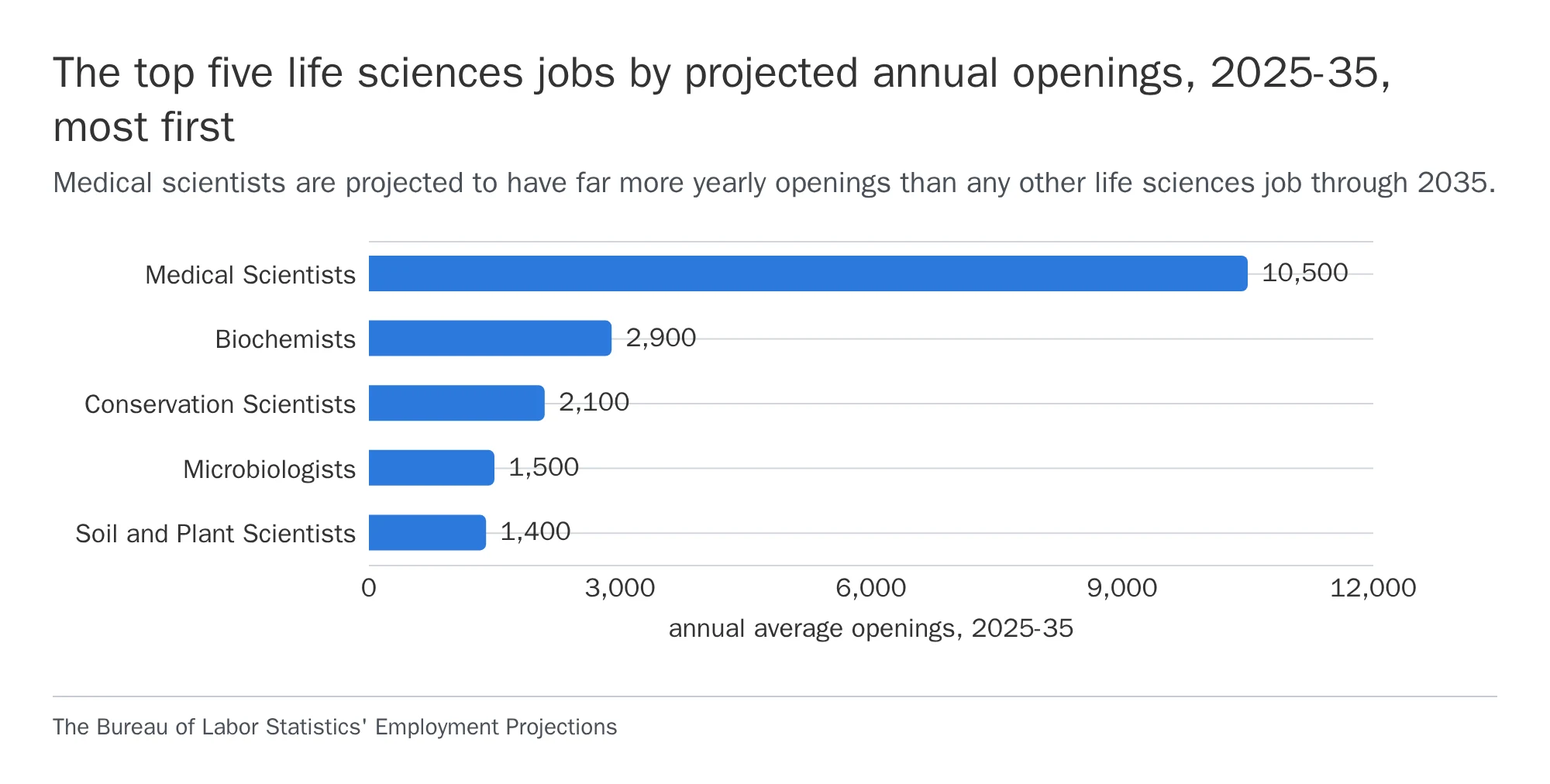
Medical scientists lead U.S. life sciences hiring by a wide margin, with 10,500 projected openings a year in the 2025–35 projections, compared with 1,400 for the typical occupation on this list. An aging population, more chronic disease and steady research spending drive most of the demand at the top. Further down the list, the drivers shift to wildfire, land and food-supply work. In every one of these jobs, BLS says many openings will come from replacing workers who retire or switch careers.
The measure is annual average job openings from 2025 to 2035, which combines new jobs from growth with openings left by workers who leave. All figures come from the Bureau of Labor Statistics' Employment Projections 2025–35 (Table 1.2), the latest release, published August 27, 2026, with base-year 2025 employment and May 2025 median pay. The published projections end in 2035, which matches the title. Ten detailed life scientist occupations qualified, and all ten appear below.
What the data shows:
- 🔬 Medical Scientists will need 10,500 workers a year, 7,600 more than Biochemists at No. 2.
- 📈 Epidemiologists have the fastest projected growth on the list at 18.7%, but only 800 openings a year.
- 💰 Biochemists earn the highest May 2025 median pay on the list at $127,410.
- 🌲 Foresters have the slowest projected growth at 2.2%, the only rate on the list below the 3.5% national average.
- 🐄 Animal Scientists rank last with 200 openings a year and a 2025 base of 3,400 jobs.
| # | Job | Annual average openings, 2025-35 | Pct change | Change | Employment base | Employment end | Median wage |
|---|---|---|---|---|---|---|---|
| 1 | Medical Scientists | 10,500 | 12.6% | 22,700 | 181,000 | 203,700 | $103,410 |
| 2 | Biochemists | 2,900 | 12.3% | 4,300 | 35,200 | 39,500 | $127,410 |
| 3 | Conservation Scientists | 2,100 | 5.3% | 1,500 | 27,700 | 29,200 | $73,010 |
| 4 | Microbiologists | 1,500 | 6.2% | 1,300 | 20,100 | 21,400 | $87,990 |
| 5 | Soil and Plant Scientists | 1,400 | 6.7% | 1,300 | 19,900 | 21,300 | $78,850 |
| 6 | Wildlife Biologists | 1,400 | 3.6% | 700 | 19,500 | 20,200 | $76,780 |
| 7 | Food Scientists | 1,000 | 6.2% | 900 | 14,100 | 14,900 | $88,720 |
| 8 | Foresters | 900 | 2.2% | 300 | 13,200 | 13,500 | $76,400 |
| 9 | Epidemiologists | 800 | 18.7% | 2,400 | 12,800 | 15,200 | $87,220 |
| 10 | Animal Scientists | 200 | 5.8% | 200 | 3,400 | 3,600 | $68,940 |
Source: U.S. Bureau of Labor Statistics, Employment Projections 2025–35, Table 1.2; employment in 2025 and projected 2035; median wage for May 2025.
Why Life Sciences Jobs Keep Hiring
Health research is the biggest engine behind this list. BLS expects the life, physical, and social science group to grow 7.5% from 2025 to 2035, the third-fastest of all 22 major job groups. The agency names growing demand for research and development, "most notably in biotechnology," as the main reason. That group grows more than twice as fast as the 3.5% average for all jobs.
The aging population matters too. BLS projects private healthcare and social assistance to add over 2.2 million jobs, about 37.0% of all new jobs through 2035. It ties that growth to "the aging population and the increasing prevalence of chronic health conditions, such as heart disease, cancer, and diabetes." Two healthcare job groups alone are expected to account for almost one-third of all new jobs through 2035. That demand flows back to the scientists who study disease and develop treatments.
Federal research money held steady during the base period. The White House had proposed cutting NIH by nearly 40%, but Congress rejected it. Congress instead gave NIH $47.2 billion for fiscal 2026, a $400 million increase over fiscal 2025, according to the Infectious Diseases Society of America. That bill, the Consolidated Appropriations Act, 2026, was signed February 3, 2026, months before the projections came out. Flat-to-rising funding supports grant-paid lab jobs, but it does not promise growth in later years, since each year's budget is decided separately.
Replacement needs fill out the rest. For every job on this list, BLS says many openings come from the need to replace workers who move to other jobs or leave the labor force, such as to retire. That is why slow-growing jobs like Foresters still post hundreds of openings each year.
1. Medical Scientists: 10,500 Openings a Year
Medical Scientists dominate the list with 10,500 projected openings a year from 2025 to 2035. The job is projected to grow 12.6%, adding 22,700 jobs. Employment rises from 181,000 in 2025 to 203,700 in 2035. That growth rate is far above the 3.5% national average.
Medical scientists design studies of human disease and test ways to prevent and treat it. They are not physicians, though some hold a medical degree as well as a Ph.D. BLS lists their May 2025 median pay at $103,410, and the typical entry requirement is a doctoral or professional degree. The job is also big: 32% work in research and development firms, and 22% work in hospitals.
BLS ties the demand directly to health care. Demand "is expected to stem from greater demand for a variety of healthcare services as the population continues to age and rates of chronic disease continue to increase." The agency says these scientists will be needed for research on Alzheimer's disease, cancer and antibiotic resistance. Steady NIH funding in fiscal 2026 also fits the timing, including $565 million for antimicrobial resistance research, according to the Infectious Diseases Society of America.
The causes explain why the job grows, but not why it posts so many openings. Size does most of that work. With 181,000 workers, even normal turnover creates thousands of openings each year, and BLS says many openings come from replacement. Readers chasing these jobs should know the entry bar is high, and many Ph.D. holders start in temporary postdoctoral posts.
2. Biochemists: 2,900 Openings a Year
Biochemists rank second with 2,900 projected openings a year. The job is projected to grow 12.3%, adding 4,300 jobs, from 35,200 in 2025 to 39,500 in 2035. That is well above the 3.5% national average. Biochemists also earn the top median pay on the list, at $127,410 in May 2025.
BLS groups biochemists with biophysicists. They study the chemistry and physics of living things, from proteins to DNA. Most work in labs, and 61% work in scientific research and development services. Another 17% work in drug and medicine manufacturing.
BLS gives two main reasons for growth. First, "the aging population will drive demand for new drugs and procedures to prevent, cure, or manage disease," which creates demand for biochemists in medical research. Second, biotech work outside health care, such as clean energy, food production and environmental protection, is expected to add jobs too. Basic research also depends on grants from universities, foundations and the federal government.
These causes do not explain the high pay, and they do not erase competition at the entry level. BLS says a Ph.D. is needed for independent research jobs. Many Ph.D. holders begin in temporary postdoctoral positions before landing permanent work.
3. Conservation Scientists: 2,100 Openings a Year
Conservation Scientists rank third with 2,100 projected openings a year. The job is projected to grow 5.3%, adding 1,500 jobs, from 27,700 in 2025 to 29,200 in 2035. That beats the 3.5% national average, but by a smaller margin than the top two. May 2025 median pay was $73,010.
Conservation scientists manage the land quality of forests, parks, rangelands and other natural resources. Government is the main employer: 27% work for the federal government, 21% for local government and 19% for state government, according to BLS. Another 20% work for social advocacy groups. A bachelor's degree is the typical entry point.
BLS names two forces behind demand. "Heightened public interest in issues involving the environment, such as protecting wildlife habitats and preserving water supplies, is expected to create demand for conservation scientists." BLS also points to a rise in wildfires, noting that preventing and suppressing fires "have become the primary concerns for managing forests and rangelands."
Wildfire and habitat work explain the growth, but not the openings count by itself. Replacement needs matter here, as BLS notes. Because so many of these jobs sit in government, budgets at every level can speed up or slow down hiring.
4. Microbiologists: 1,500 Openings a Year
Microbiologists rank fourth with 1,500 projected openings a year. The job is projected to grow 6.2%, adding 1,300 jobs, from 20,100 in 2025 to 21,400 in 2035. That is faster than the 3.5% national average. May 2025 median pay was $87,990, and a bachelor's degree is the typical entry level.
Microbiologists study bacteria, algae, fungi and other tiny organisms. They are not clinical laboratory technologists, who run patient tests in a separate healthcare job category. The largest employers are research and development firms at 21% and government at 20%, followed by drug and medicine manufacturing at 14%.
BLS links the growth to drugmaking. Microbiologists "are expected to be needed to help pharmaceutical and biotechnology companies develop new drugs that are produced with the aid of microorganisms," according to the BLS outlook. Demand for biofuels and efforts to protect the environment and public health also support hiring.
The causes do not remove funding risk. BLS notes that microbiologists often depend on grants awarded through a highly competitive process. Jobs tied to research budgets can rise and fall with each year's funding.
5. Soil and Plant Scientists: 1,400 Openings a Year
Soil and Plant Scientists rank fifth with 1,400 projected openings a year, tied with Wildlife Biologists. The job is projected to grow 6.7%, adding 1,300 jobs, from 19,900 in 2025 to 21,300 in 2035. That is about twice the 3.5% national average. May 2025 median pay was $78,850.
These scientists work to improve crop yields and soil health through crop breeding, soil management and pest control. They are part of the broader agricultural and food scientist group. Some states require a license for plant and soil scientists.
BLS ties hiring in this group to farming challenges. The need to address "pests, disease, and changing climate and weather patterns is expected to create jobs" for agricultural and food scientists, BLS says. Demand for farm products is also expected to help. That explanation covers the whole group of 37,400 workers in 2025, which BLS projects to grow 6%, not soil and plant scientists alone.
The Other 5: What's Driving Their Hiring
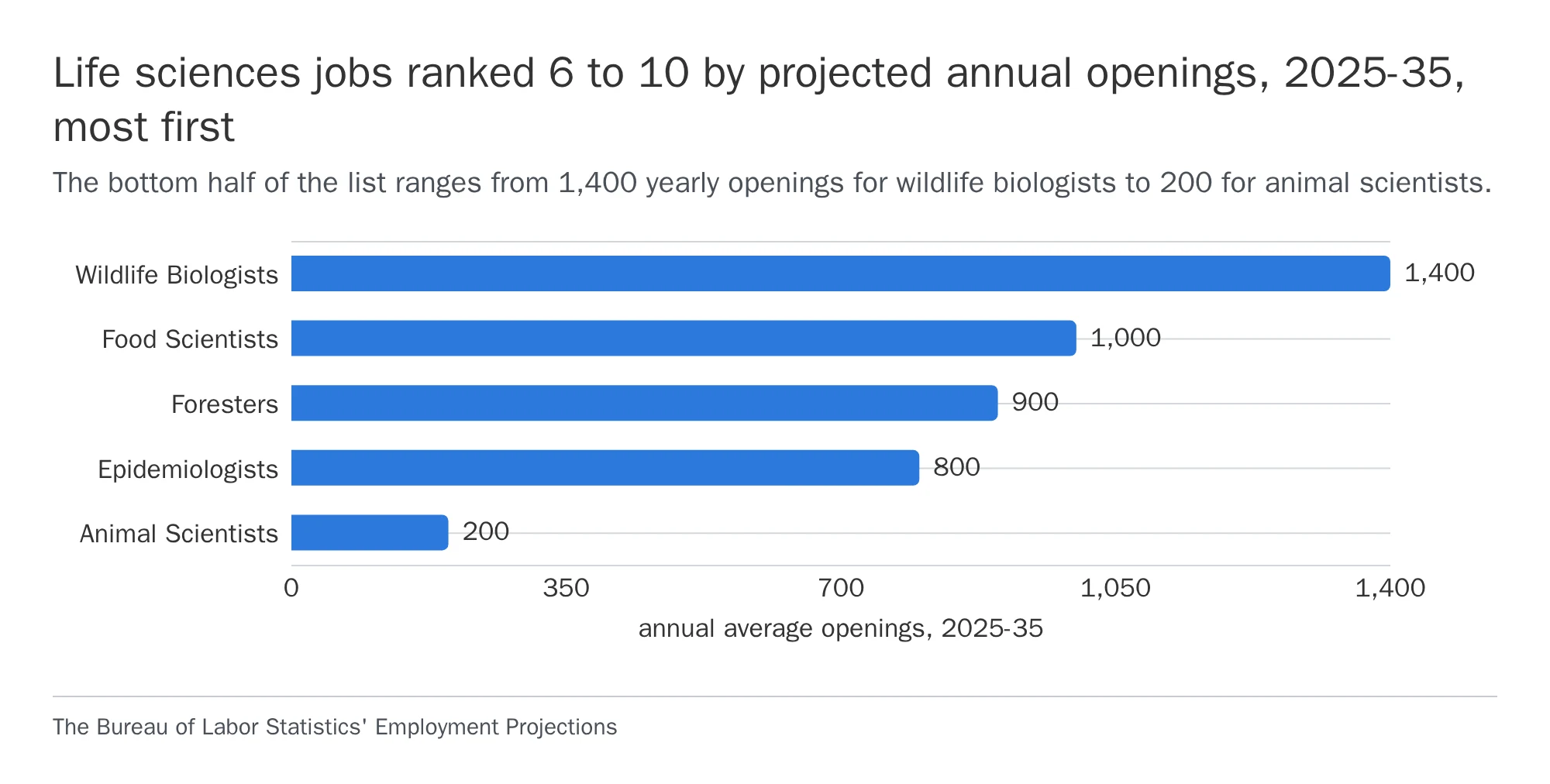
- Wildlife Biologists (1,400 openings a year): BLS says they are needed to fight biodiversity loss and research changing ecosystems, but government budgets may limit demand.
- Food Scientists (1,000 openings a year): Demand for farm products and research into pests and disease help explain growth across the agricultural and food scientist group.
- Foresters (900 openings a year): BLS says more wildfires and more people living near forests will keep foresters needed to manage fire impacts.
- Epidemiologists (800 openings a year): BLS expects demand to rise as better healthcare technology finds new and emerging diseases, with public budgets a key swing factor.
- Animal Scientists (200 openings a year): Livestock research falls under the same agricultural forces BLS cites for the whole agricultural and food scientist group.
Just Missed the List
No life sciences occupation in the dataset just missed the list, because all ten qualifying occupations made it. The closest jobs to the cutoff sit at the bottom: Foresters with 900 openings a year, Epidemiologists with 800 and Animal Scientists with 200. Animal Scientists rank last because the job is small, with 3,400 workers in 2025. Epidemiologists are a different case: they have the fastest growth on the list at 18.7%, but a 2025 base of just 12,800 jobs keeps openings low.
How These Jobs Compare to the Rest of the Economy
Nine of the ten jobs beat the all-occupation growth rate of 3.5% for 2025 to 2035. Total U.S. employment is projected to rise from 170.3 million to 176.2 million over that decade. That pace is slower than the 10.9% growth BLS recorded for 2015 to 2025. Only Foresters trail the national rate, at 2.2%. Wildlife Biologists barely clear it, at 3.6%.
| Compared with 3.5% national growth | Jobs |
|---|---|
| Well above (10% or more) | Epidemiologists (18.7%), Medical Scientists (12.6%), Biochemists (12.3%) |
| Above (5% to 9.9%) | Soil and Plant Scientists (6.7%), Microbiologists (6.2%), Food Scientists (6.2%), Animal Scientists (5.8%), Conservation Scientists (5.3%) |
| Near the average | Wildlife Biologists (3.6%) |
| Below | Foresters (2.2%) |
Pay also runs high. Every job on the list had a May 2025 median above the $50,980 median for all workers. Even the lowest, Animal Scientists at $68,940, beat it.
What's Not in the Data
- Projections are estimates, not guarantees. BLS warns that precise figures do not capture the uncertainty of long-range forecasts.
- Openings combine new jobs from growth with openings left by workers who retire or change careers.
- The projections were published August 27, 2026, and do not reflect policy or budget changes made after that.
- Median pay is a national figure from May 2025 and varies by state, industry and employer.
- The figures count only the detailed occupations shown. Related workers classified under other occupation codes are not included.
FAQs
Which life sciences job will have the most openings through 2035?
Medical Scientists. BLS projects 10,500 openings a year from 2025 to 2035, far ahead of Biochemists at 2,900. The job is projected to grow 12.6%, from 181,000 workers in 2025 to 203,700 in 2035.
What is the fastest-growing life sciences job?
Epidemiologists, at 18.7%. That is the highest projected growth rate on this list for 2025 to 2035. Because the job is small, with 12,800 workers in 2025, it adds only 2,400 jobs and about 800 openings a year.
Which life sciences job pays the most?
Biochemists, at $127,410. That was the May 2025 median pay for biochemists and biophysicists. Medical Scientists came next at $103,410. Both jobs typically require a doctoral or professional degree.
Do you need a Ph.D. to work in life sciences?
No. Medical Scientists and Biochemists typically need a doctoral or professional degree, but many jobs on this list start with a bachelor's degree. Microbiologists, Conservation Scientists and Wildlife Biologists all list a bachelor's as the typical entry level. Epidemiologists typically need a master's.
Are life sciences jobs growing faster than average?
Yes. Nine of the ten jobs here beat the 3.5% projected growth for all U.S. jobs from 2025 to 2035. Only Foresters, at 2.2%, trail it. BLS projects the broader life, physical and social science group to grow 7.5%.
How much does an epidemiologist make?
$87,220. That was the May 2025 median pay for epidemiologists. Pay varies by employer; BLS reports a median of $127,410 in scientific research and development services, compared with $84,410 in state government.
Will federal budget cuts hurt life sciences hiring?
No, not for fiscal 2026. Congress gave NIH $47.2 billion for fiscal 2026, a $400 million increase over fiscal 2025. It rejected a proposed cut of nearly 40%. Later budgets are not settled, and BLS says public funding affects epidemiologists, microbiologists and wildlife biologists.
How This List Was Built
The list ranks occupations by annual average openings from 2025 to 2035, from the BLS Employment Projections 2025–35, Table 1.2. Employment figures are for 2025 and projected 2035, and median pay is for May 2025. A life sciences job here means a detailed occupation in the BLS life scientists group: Medical Scientists (SOC 19-1042), Biochemists (19-1021), Conservation Scientists (19-1031), Microbiologists (19-1022), Soil and Plant Scientists (19-1013), Wildlife Biologists (19-1023), Food Scientists (19-1012), Foresters (19-1032), Epidemiologists (19-1041) and Animal Scientists (19-1011). Ten occupations passed every data rule, and no row was excluded. Biological technicians, clinical laboratory technologists and technicians, and pharmacists fall under other BLS occupation groups, so they are not part of this ranking.