

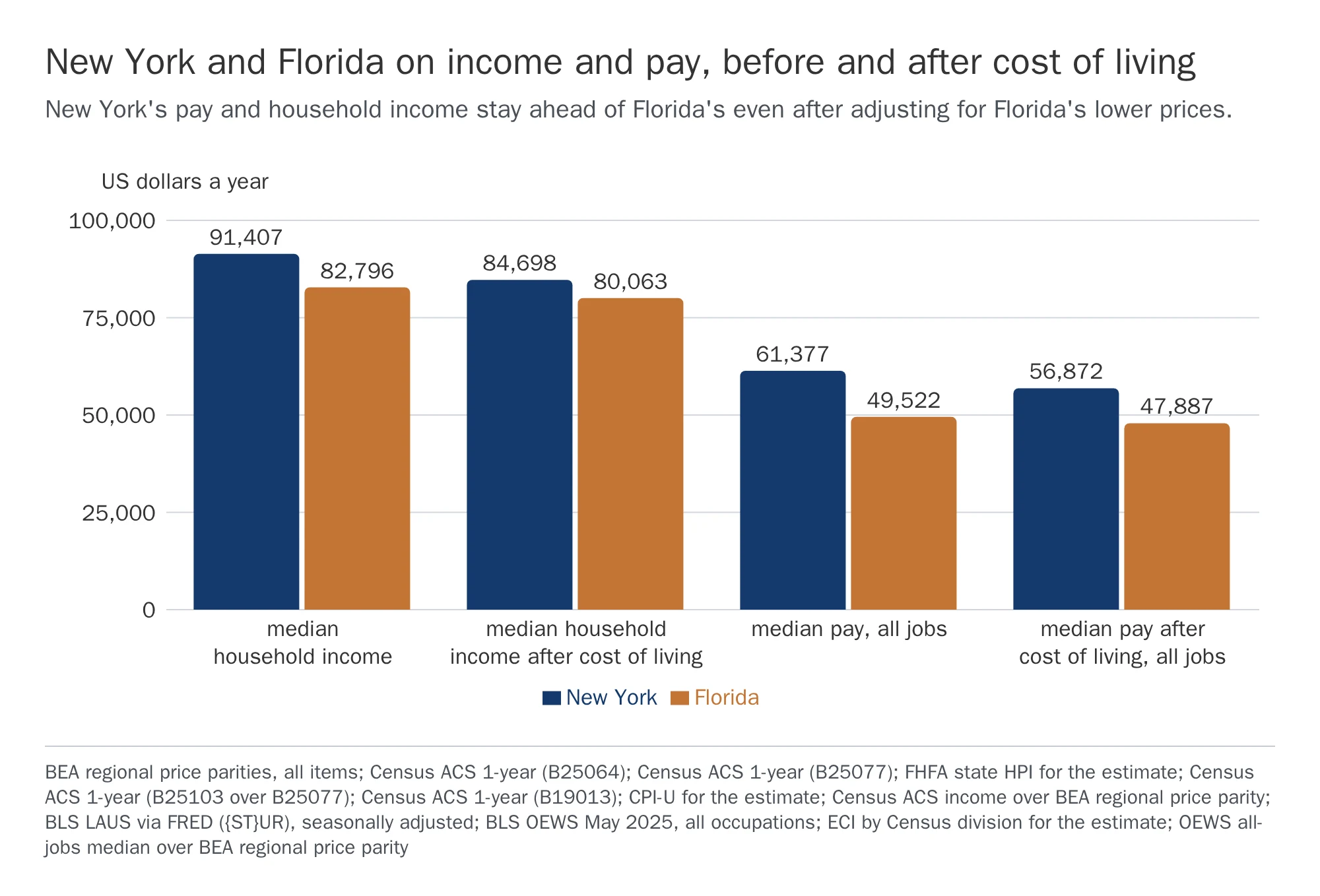
New York comes out ahead of Florida on 6 of 9 measures, and the deciding gap is pay: the median job pays $56,872 in New York after cost of living, compared with $47,887 in Florida. Florida does win on what housing costs a buyer. Its median home value is $101,079 lower, and its property tax takes 0.75% of home value a year, against 1.45% in New York. Higher pay in New York, lower prices and taxes on Florida homes, and a Florida job market that has cooled in 2026 explain most of the picture.
This comparison covers nine measures: overall prices, rent, home value, property tax rate, household income, household income after cost of living, unemployment, median pay and median pay after cost of living. The figures come from the BEA's regional price parities (2024), the Census Bureau's American Community Survey (2024), BLS wage estimates (May 2025) and BLS unemployment rates (August 2026, the latest month published). Rent, home value, household income and pay are 2026 estimates, built by moving the latest reported figure forward with a price or wage index. This 2026 article rests on the latest published figures, and no measure was dropped by a data rule.
What the data shows:
- 💵 Median pay for all jobs is an estimated $61,377 in New York for 2026, $11,855 (24%) more than Florida's $49,522.
- 🏠 Florida's estimated 2026 median home value is $405,036, about 20% below New York's $506,115.
- 🧾 Property tax takes 0.75% of home value a year in Florida in 2024, about half of New York's 1.45%.
- 🔑 Renters pay more in Florida: the estimated 2026 median gross rent is $1,938 a month, $190 above New York's $1,748.
- 📉 Florida's unemployment rate was 4.5% in August 2026, 0.2 points above New York's 4.3%.
| Measure | New York | Florida | Gap | Period |
|---|---|---|---|---|
| Overall price level (U.S. = 100) | 107.92 | 103.41 | Florida 4.5 points lower | 2024 |
| Median gross rent, per month | $1,748 | $1,938 | New York $190 lower (9.8%) | 2026 estimate from 2024 |
| Median home value | $506,115 | $405,036 | Florida $101,079 lower (20%) | 2026 estimate from 2024 |
| Property tax as a share of home value | 1.45% | 0.75% | Florida 0.7 points lower | 2024 |
| Median household income | $91,407 | $82,796 | New York $8,611 higher (10%) | 2026 estimate from 2024 |
| Median household income after cost of living | $84,698 | $80,063 | New York $4,635 higher (5.8%) | 2026 estimate / 2024 prices |
| Unemployment rate | 4.3% | 4.5% | New York 0.2 points lower | August 2026 |
| Median pay, all jobs | $61,377 | $49,522 | New York $11,855 higher (24%) | 2026 estimate from May 2025 |
| Median pay after cost of living, all jobs | $56,872 | $47,887 | New York $8,985 higher (19%) | 2026 estimate / 2024 prices |
Source: BEA regional price parities; Census Bureau American Community Survey 1-year (tables B25064, B25077, B25103, B19013); FHFA state house price index and CPI-U for the estimates; BLS Occupational Employment and Wage Statistics, May 2025, with the Employment Cost Index for the estimate; BLS Local Area Unemployment Statistics, seasonally adjusted.
Why New York and Florida Differ
Three forces drive most of the gap. The first is pay. New York's typical job pays far more, and Florida's lower prices close only part of that gap. Average weekly wages in Florida's 25 largest counties trailed the national average of $1,173 in the third quarter of 2020, WUSF reported, and the gap was worst in tourism, the state's largest industry. Hector Sandoval of the University of Florida's Bureau of Economic and Business Research told WUSF that many Florida jobs are "kind of low skill" and "tend to be low wage."
The second force is the cost of owning a home. Florida home prices slipped while New York's kept climbing. The FHFA's 2025 fourth-quarter report found Florida had the nation's steepest annual price decline, at 2.7%. New York homes rose 3.53% in the year to the second quarter of 2026, compared with 0.96% in Florida, per the FHFA's 2026 second-quarter tables.
The third force is a cooling Florida job market. Florida's unemployment rate reached 4.8% in April 2026, up 1.1 points from a year earlier, according to the state's labor market release. Insurance Journal, reprinting Bloomberg, tied the slowdown to a pullback in real estate, retail and tourism.
Movers keep heading south anyway. In 2024, 50,661 people moved from New York to Florida, while 28,080 moved the other way. That left Florida with a net gain of 22,581 New Yorkers. About 415,449 people left New York for other states in 2024 and 285,304 moved in, according to Census figures reported by NEWS10. That left a net loss of 130,145 residents.
Overall Price Level: 103.41 in Florida vs 107.92 in New York
Everyday prices in Florida ran 4.5 points lower than New York's in 2024 on BEA's scale, where the U.S. average is 100. Both states cost more than the typical state. The BEA's 2024 price parity release says housing rents are often the main driver of differences in these price levels. A household moving south pays a little less for the same basket of goods and services, but the savings are modest next to the pay gap.
Rent: $1,938 in Florida vs $1,748 in New York
Rent is the one housing cost that runs higher in Florida, by an estimated $190 a month in 2026. Florida's rents surged as newcomers arrived. A 2025 University of Florida Shimberg Center study, reported by WLRN and the Florida Phoenix, found median rents rose 39% from 2019 to 2023. Over that span, Florida added more than 1 million households, nearly 195,000 of them renters. The center's Anne Ray said strong population growth "collided with limited housing supply."
On the New York side, a large share of rentals have their increases limited by law. About one million New York City apartments are rent stabilized, making up 41% of the city's rental apartments, according to the city's Independent Budget Office in May 2026. The Rent Guidelines Board's 2025 report puts stabilized units at 41.3% of occupied rentals, which helps explain why New York's statewide median stays lower than many expect. Renters moving south should budget for a higher monthly bill, not a lower one.
Home Value: $405,036 in Florida vs $506,115 in New York
The typical Florida home is worth an estimated $101,079 less than New York's in 2026. The two markets moved in opposite directions in the last two years. The FHFA's 2025 fourth-quarter report showed Florida with the largest annual decline of any state. Florida's single-family market has since steadied. Florida Realtors reported a July 2026 single-family median of $425,000, up 3.7% from a year earlier, while the condo-townhouse median held at $295,000.
New York's prices kept rising on a thin supply of homes for sale. The New York State Association of Realtors reported 30 straight months of rising medians, Spectrum News reported in March 2026. Its January figures showed the median climbing from $415,000 in 2025 to $445,000 in 2026. A buyer selling a New York home and buying a typical Florida one can expect money left over.
Property Tax Rate: 0.75% in Florida vs 1.45% in New York
New York homeowners pay close to twice Florida's property tax rate. On a home of equal value, that means a far larger yearly bill in New York. Schools are the biggest reason. The New York State Tax Department reports that school taxes made up 62.2% of property tax levies outside New York City in fiscal years ending in 2025. It ranks New York third in property tax per person, at $3,454 against a U.S. figure of $2,025.
Florida limits how fast taxes on a primary home can grow. Under the Save Our Homes rule, the assessed value of a homesteaded home can rise no more than 3% or the change in inflation, whichever is less, per the Pinellas County Property Appraiser. Florida's homestead exemption is $51,411 for 2026, according to Florida TaxWatch. The cap protects only a primary residence, so a second home or rental in Florida gets less of this break.
Household Income: $91,407 in New York vs $82,796 in Florida
The typical New York household earns an estimated $8,611 more than Florida's in 2026. This is pretax income, so it does not show what each state's income tax takes. Florida has no state income tax on wages. New York began cutting rates for middle-income filers with tax year 2026. Governor Kathy Hochul's office said the cut covers more than 75% of filers, with savings for joint filers earning up to $323,000. A second step takes effect in tax year 2027, per a client alert from Anchin.
Household Income After Cost of Living: $84,698 in New York vs $80,063 in Florida
New York's household income lead shrinks to $4,635 once each state's price level is taken into account. This figure divides household income by the BEA price level, so Florida's lower prices narrow the gap by about half. New York households still keep the edge in buying power, though the gap is small enough that taxes and housing choices can easily swing it for a given family.
Unemployment: 4.5% in Florida vs 4.3% in New York
Florida's job market, long one of the nation's tightest, now trails New York's. Florida's rate stood at 4.5% in August 2026, ranking 39th among states, per BLS state rankings. The state's April 2026 release showed seven of ten major industries losing jobs over the year. New York's rate fell from 4.5% in August 2025 to 4.3% in August 2026, per the BLS summary. Anyone moving south without a job lined up faces a slightly tougher search than a year ago.
Median Pay: $61,377 in New York vs $49,522 in Florida
The median job pays an estimated $11,855 more in New York in 2026, the largest gap in this comparison. Florida's job mix is a big part of the reason. The WUSF report described tourism, the state's largest industry, as one where the pay gap with the rest of the nation is especially wide. A worker who keeps the same kind of job should check pay offers in that line of work rather than assume Florida pay will match.
Median Pay After Cost of Living: $56,872 in New York vs $47,887 in Florida
Even after Florida's lower prices, the median New York job pays $8,985 more. This measure divides median pay by each state's price level. Florida's 4.5-point price advantage closes only about a quarter of the pay gap. For a typical worker, moving to Florida means less buying power from a paycheck unless the move also brings a raise or tax savings.
Who Comes Out Ahead
Buyers and owners come out ahead in Florida. The median home costs $101,079 less, and the tax rate on it is about half of New York's.
Renters come out ahead in New York. Florida's median rent runs $190 a month higher, and its median pay is lower.
High earners stand to gain the most from Florida's lack of a state income tax. New York's top rates range from 9.65% to 10.9%, per the Anchin alert, and pretax figures here do not capture that difference.
Retirees who live on savings and own their home gain from Florida's lower home prices and property tax rate. Their pay matters less, so New York's wage lead does less for them.
Remote workers who keep a New York-level salary capture Florida's lower prices and taxes without taking a Florida pay cut. Workers who must find a local job face Florida's lower median pay and higher unemployment.
How New York and Florida Compare to the U.S.
Both states cost more than the nation as a whole. On BEA's scale for 2024, the U.S. equals 100, New York stands at 107.92, and Florida at 103.41. The highest state, California, came in at 110.7, per the BEA release. Neither New York nor Florida is among the nation's most expensive states on that measure, but neither is a low-cost state.
What's Not in the Data
Income and pay figures are before taxes. Florida has no state income tax, while New York taxes wages, so take-home pay gaps are smaller than the pretax ones.
Homeowners insurance is not counted. Florida premiums remain high, though they are easing. Florida was the only state with a homeowners rate decrease in 2025, falling 0.92%, according to an S&P Global report cited by Florida Realtors.
Statewide figures hide large local differences. New York City and upstate New York differ sharply, as do Miami and inland Florida.
Four of the nine figures are 2026 estimates, not survey results for 2026. The price level dates to 2024.
FAQs
Is it cheaper to live in Florida than New York?
Yes, slightly. Florida's overall price level was 103.41 in 2024, against 107.92 in New York, where the U.S. equals 100. Florida's estimated 2026 median rent is higher, though, at $1,938 a month versus $1,748.
How much more do jobs pay in New York than in Florida?
$11,855 more at the median. The median job pays an estimated $61,377 in New York and $49,522 in Florida in 2026. After cost of living, New York still leads by $8,985.
How many New Yorkers moved to Florida?
50,661 in 2024. That year, 28,080 people moved from Florida to New York, leaving Florida a net gain of 22,581 New Yorkers, according to the Census Bureau's state-to-state migration flows.
Are property taxes lower in Florida than in New York?
Yes. Property tax took 0.75% of home value a year in Florida in 2024, compared with 1.45% in New York. Florida also caps yearly assessment increases on a primary home at 3% or inflation, whichever is less.
Is rent cheaper in Florida or New York?
New York. The estimated 2026 median gross rent is $1,748 a month in New York and $1,938 in Florida, a $190 gap. Florida rents rose 39% from 2019 to 2023, a University of Florida study found.
What is the unemployment rate in Florida compared with New York?
4.5% in Florida, 4.3% in New York, as of August 2026. Florida's rate had reached 4.8% in April 2026, up 1.1 points from a year earlier.
Will Florida property taxes change after the 2026 election?
It depends on Amendment 3, which voters will decide on November 3, 2026. It would raise the homestead exemption on non-school taxes to $150,000 in 2027 and $250,000 in 2028. It needs 60% approval to pass.
How This Comparison Was Built
The comparison sets New York against Florida on nine measures and counts which state a reader is better off in on each. Lower is better for the price level, rent, home value, property tax rate and unemployment; higher is better for the four income and pay measures. New York wins six measures and Florida wins three. The price level comes from BEA regional price parities for 2024 (U.S. = 100). Rent (Census table B25064), home value (B25077), property tax rate (B25103 divided by B25077) and household income (B19013) come from the 2024 American Community Survey 1-year estimates. Median pay comes from BLS Occupational Employment and Wage Statistics for May 2025, all occupations. Unemployment is the BLS seasonally adjusted rate for August 2026. Rent, home value, household income and median pay are 2026 estimates: each reported figure is multiplied by the change in an index from its reference period to the latest period in 2026, using the FHFA state house price index for home value, CPI-U for income, and the Employment Cost Index by Census division for pay. The two after-cost-of-living measures divide income or pay by the BEA price level, at 2024 prices. The pair was chosen from Census Bureau 2024 state-to-state migration flows. No row was excluded by a data rule.