

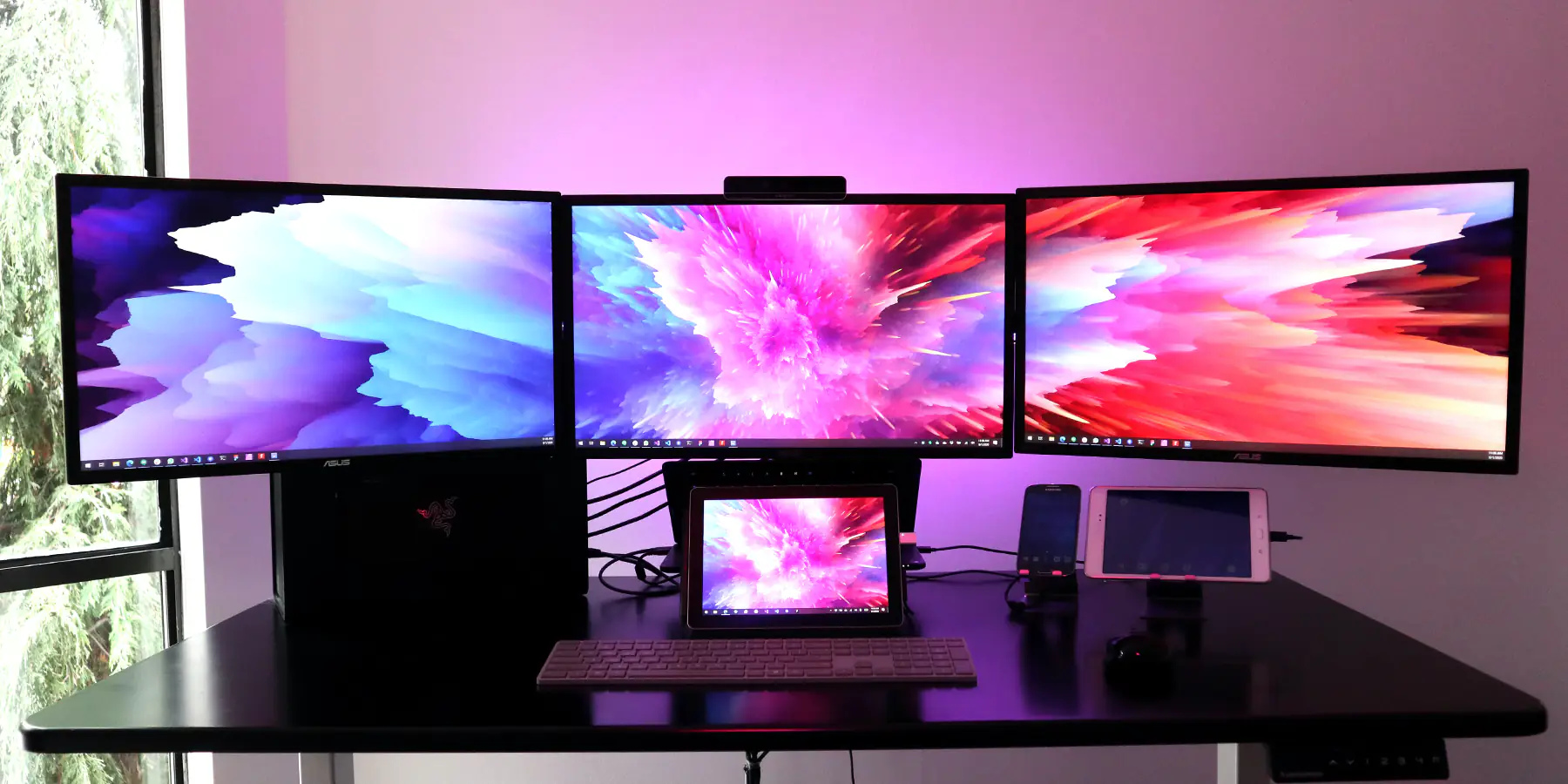
Part of your productivity in the office comes down to your computer’s monitor. This hardware has to match the kind of work you’re going to do or else your productivity is going to suffer. These are the things to consider when you’re looking to scale up your virtual real estate:
- What size will work best for you: 24-inch, 27-inch, or 32-inch?
- How important are resolution and multiple display setups to your workflow?
- What's your budget?
24-Inch Monitors for Office Work
24-inch monitors are the standard fair of larger computer monitors. Thanks to monitors becoming thinner over the last decade, these monitors cut back on both horizontal space and depth required on your desk.
Because of the space savings, 24-inch monitors are common for multi-display setups. The screens can easily fit on your desk, giving you plenty of space to work with on both your physical and virtual desktop.
However, since 24-inch monitors are smaller, they don’t offer as much space to have multiple windows up. If your work leads you to have lots of windows open, then 24-inch monitors may not cut it.
What We Love
- 24-inch monitors take up less space than the other sizes we’ll review.
- These monitors tend to be the most budget-friendly options on the market.
- These monitors don’t lose any function by being smaller.
Things to Consider
- Will 24 inches be enough space for you to do your work?
- Will a lower resolution affect your work?
Top Pick: 24-Inch, 1080p Monitor for Office Work


HP 24mh
HP’s 23.8-inch FHD 1080p monitor is a great monitor for office work. Its anti-glare screen and height-adjustable stand. Also, with a maximum resolution of 1920 x 1080 at 75Hz you have a high-resolution image that is clear and concise.
All of these features combine to make a monitor that increases your productivity without tiring out your eyes or creating visual distractions.
What We Love
- Height-adjustable and rotating stand for orientations that work best for you.
- Connects easily with HDMI and DVI ports.
Things to Consider
- Some consumers have reported losing columns of pixels after months of use.
- You may need additional parts for mounting.
27-Inch Monitors for Office Work
The extra viewing space lets you open up more windows or programs to get your work done, making multitasking simpler and easier.
Because screen measurements are done across the diagonal of the screen, these monitors also don’t take up too much more room compared to their 24-inch counterparts. Most 27-inch screens will measure about one inch wider than a 24-inch screen, making them similar in size overall.
Still, that doesn’t mean that the space won’t be missed. One inch, especially when using two or more displays, can add extra space used up on the desktop. If you’re in a cramped cubicle or you own a smaller-sized desk, running more than one of these displays could be a problem.
27-inches is the ideal sweet spot for most business apps like email clients, Excel or spreadsheet apps, and industry-specific apps like AutoCAD.
What We Love
- The size and resolution of the screen make them versatile in the work they accommodate.
- 27-inch monitors come in a wide range of prices to fit your budget.
Things to Consider
- If you need multiple monitors, will your desk be able to fit two 27-inch monitors?
- Does the increased resolution help your productivity?
Top Pick: 27-Inch, 1440p Monitor for Office Work


Dell U2719D
For us, the U2719D from Dell is the top pick for a 27-inch office work monitor. The display features a 2k resolution and on-screen video settings to help you get the look you want from your monitor.
The stand that comes with the monitor is adjustable for ergonomic purposes, and the bezel of the screen is thin enough to not be distracting when running multiple displays at your workstation.
What We Love
- Color and video settings make this a great monitor for color-specific work.
- The size of the screen makes this a good choice for visual design projects.
Things to Consider
- This model doesn’t have a built-in speaker.
- Because of the 60Hz refresh rate, gamers may experience tearing.
Budget Pick: 27-Inch, 1080p Monitor for Office Work


HP M27ha
HP’s M27ha is a solid choice for those wanting a 27-inch monitor but are on a budget. The display can only go up to 1080p, but it offers many of the strengths of a similar 27-inch display. Since you are working with a larger screen than a 24-inch, the pixel density may be lower since the pixels are more spread out.
The blue light settings of the monitor make reading text on this monitor easier on the eyes, and the monitor features a wide variety of ports to ensure that you can connect to almost any computer.
What We Love
- The adjustable stand and blue light settings improve productivity by increasing your comfort while working.
- This monitor is VESA-compatible for any mounting options you want to use.
Things to Consider
- Because of the lower resolution, the display will not be as clear as other 27-inch options.
- Firmware issues with game consoles or Apple computers can cause audio problems.
32-Inch Monitors for Office Work
The size of a 32-inch monitor is the main appeal for getting one of these for your office work. The extra five inches of diagonal space means that the screen is about two inches wider than a 27-inch screen or three inches wider than a 24-inch monitor.
Because of their size, these monitors will take up much more space on your desk than other sizes. This fact is obvious when you try to run multiple displays with 32-inch monitors. That three-inch difference from a 24-inch monitor doubles if you run two displays, so you’ll want to make sure you have a big enough workspace to use these monitors.
Vision also factors into using a 32-inch monitor. As you go up in size, your eyes should be farther away from the screen to reduce strain over the workday. Eye strain can make you feel tired or sleepy as the muscles in your eyes are fatigued from being focused on the screen for so long. Being about four feet from a 32-inch monitor is the recommended distance for optimal use.
What We Love
- The large screen makes it easy to have multiple windows open while working to increase your productivity.
- These monitors tend to come in high resolutions, making them great for detailed work such as architectural schematics or computer coding.
- You can alleviate some of the need to run multiple monitors thanks to the size of the screens.
Things to Consider
- These monitors are large, meaning that they might not fit in a small workspace.
- 32-inch monitors tend to run on the expensive side.
Top Pick: 32-Inch, 4K Monitor for Office Work


LG 32UN650-W
LG offers their 32UN650-W as a great choice for workplace 32-inch monitors. Their DCI-P3 color gamut feature allows for great color matching work, and the IPS display makes for clear reading and viewing on this monitor. The adjustable stand and near-borderless screen mean that this screen offers ergonomic and multi-screen options for your workspace.
What We Love
- The 4K resolution lets pictures and color be extra crispy, with design work especially being easier to accomplish.
- The backlight on this model doesn’t bleed much, so you won’t have light interference while trying to get your work done.
Things to Consider
- The power cord for this model is roughly five feet, so it needs to be close to the power or have an extension cable paired with it.
- The stand is made of thin plastic, so mounting the monitor will be more secure than using the stand.
Budget Pick: 32-Inch, 1440p Monitor for Office Work


LG 32QN600-B
The LG 32QN600-B is a great budget option if you need a 32-inch monitor for less cash than our top pick.
The display outputs a 2K resolution over the standard 4K but otherwise works similar to LG’s 32UN650-W model. It even offers the same DCI-P3 color gamut options and IPS display. The bezel on the sides and top of the monitor is also thin, making this great for multiple display setups.
What We Love
- A great buy for the price, considering the amount of virtual desktop space and resolution you get.
- The maximum brightness of 350 nits is brighter than the 250 nits industry average.
Things to Consider
- This monitor only outputs via HDMI, so you may need adapters to connect multiple of these to your computer.
- The lower resolution could make artistic or design work harder due to the loss of visual clarity.
Monitor Sizing Explained
A bigger monitor isn’t necessarily better. If you’re not familiar with the different sizes of monitors we’ve covered here, then here’s a brief overview of the sizes and what they offer.
32-Inch
32-inch monitors measure around 32 inches from one corner to the opposite corner. These large monitors can take up a good amount of desk space but allow for more windows to be clearly visible on your desktop. These monitors also tend to be somewhat expensive thanks to being in the 2K to 4K resolution range.
27-Inch
Measuring at 27 inches diagonally across the screen, these monitors are a little larger than the standard ones used for office work. 27-inch monitors of this size usually have resolutions in the 1080p to 1440p range.
24-Inch
These monitors measured 24 inches from one corner to the opposite corner across the screen. 24-inch monitors tend to make good choices for budget or multi-display setups.
Monitor Resolutions
Each monitor will also have a screen resolution, which is the number of pixels the screen can display at once. The more pixels, the better the level of detail you can see. Here are some of the common screen resolutions you can find on office work monitors.
4K
This is one of the highest resolutions out there right now for office monitors. This screen resolution can display almost 4,000 horizontal pixels, hence the 4k name. The official resolution for these monitors is 3840 x 2160 pixels, making these monitors great for visual work like photo and video editing, viewing fine print or small details, and analyzing artifacts.
1440p or 2K
Monitors with this resolution can display half as many pixels as the 4k monitors. With a 2048 x 1440p pixel display, monitors of this resolution are similar to 1080p monitors but with a larger horizontal display. The increased display will give you a little more space for extra windows or workspaces on your desktop, but not much else.
1080p
This resolution, measuring 1920 x 1080, has been the standard high-definition choice for a while now. It’s become the budget option for workstations as 2K, and 4K resolutions have entered the market and driven 1080p monitor prices down. This resolution can fit into smaller monitors, making it great for multi-screen workspaces.
Best Overall Monitor for Office Work
When choosing the best monitor for your office work, it’s important to think about what kind of features you need to make the most out of your time. An administrator won’t need the resolution or color depth that a designer or architect needs. Size can be a big factor, too. If you can’t afford the space for a larger display, then you’ll have to look for smaller options.
While all of the options we’ve talked about here have weight, we recommend Dell’s U2719D 27-inch monitor for most office work. The 27-inch size is a good compromise between desk space requirements, offered resolution, and features for most of the common tasks in the office.