

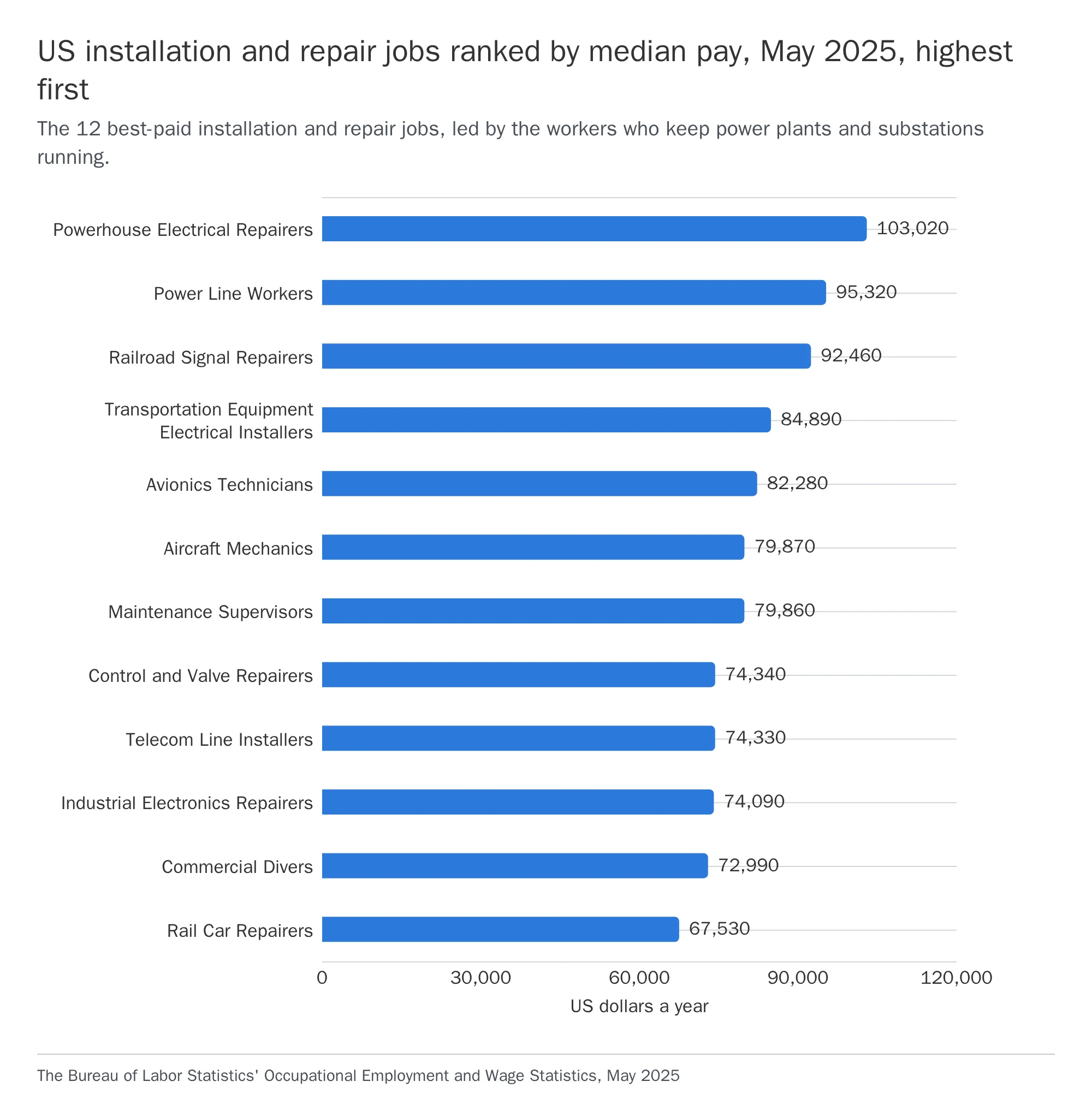
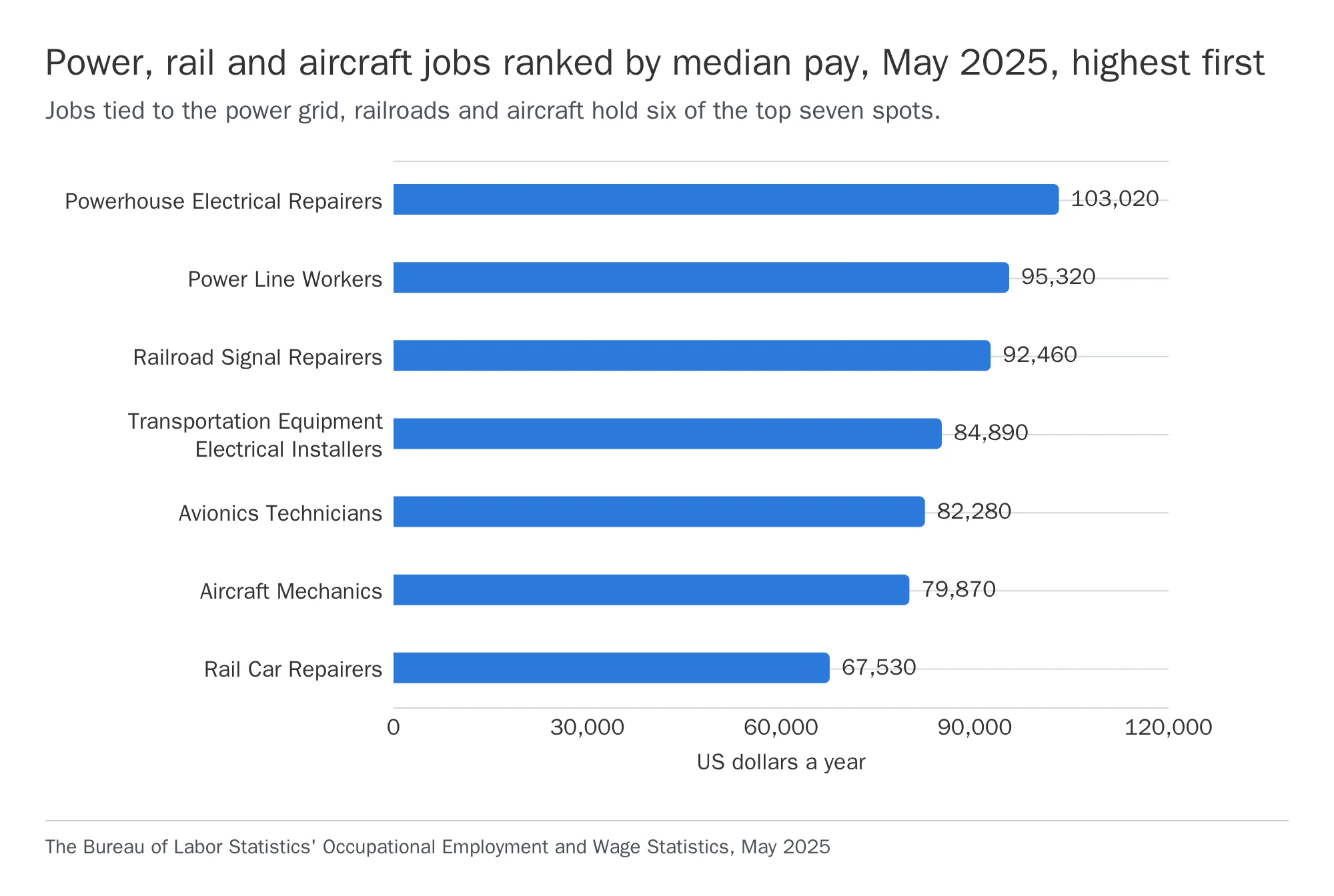
Powerhouse electrical repairers top the list with a median pay of $103,020 in May 2025, well above the $60,850 earned by the typical installation and repair job. The jobs at the top share a few traits. They work on the power grid, railroads and aircraft, where a mistake can kill someone or shut down a system. Many are covered by union contracts, and many need years of training or federal certification.
The ranking uses median annual pay from the Bureau of Labor Statistics' Occupational Employment and Wage Statistics survey for May 2025, the latest figures BLS has published. This 2026 article rests on those May 2025 figures, since no newer national data exists yet. Each job had to pass the dataset's rules on size, a consistent job code and a national cross-check, and 49 installation, maintenance and repair jobs qualified. The table shows the top 25.
What the data shows:
- ⚡ Power jobs hold the top two spots: powerhouse electrical repairers at $103,020 and power line workers at $95,320.
- 🚆 Railroad signal repairers rank third at $92,460, just $2,860 behind power line workers.
- ✈️ Aircraft work fills the next tier, with avionics technicians at $82,280 and aircraft mechanics at $79,870.
- 👷 Maintenance supervisors are the largest job on the list with 617,500 workers, earning $79,860.
- 🌊 Commercial divers have the widest pay range, with the top 10% earning more than $157,790.
| # | Job | Median pay (May 2025) | Employment | Bottom 10% earn under | Top 10% earn over |
|---|---|---|---|---|---|
| 1 | Powerhouse Electrical Repairers | $103,020 | 20,720 | $65,730 | $129,920 |
| 2 | Power Line Workers | $95,320 | 131,070 | $51,470 | $128,690 |
| 3 | Railroad Signal Repairers | $92,460 | 8,720 | $62,610 | $119,550 |
| 4 | Transportation Equipment Electrical Installers | $84,890 | 6,940 | $50,750 | $116,810 |
| 5 | Avionics Technicians | $82,280 | 18,830 | $49,410 | $113,680 |
| 6 | Aircraft Mechanics | $79,870 | 138,090 | $48,780 | $128,890 |
| 7 | Maintenance Supervisors | $79,860 | 617,500 | $49,600 | $126,790 |
| 8 | Control and Valve Repairers | $74,340 | 48,240 | $45,910 | $112,500 |
| 9 | Telecom Line Installers | $74,330 | 97,720 | $45,310 | $103,680 |
| 10 | Industrial Electronics Repairers | $74,090 | 65,010 | $46,840 | $105,590 |
| 11 | Commercial Divers | $72,990 | 3,450 | $43,330 | $157,790 |
| 12 | Rail Car Repairers | $67,530 | 21,350 | $46,800 | $95,100 |
| 13 | Watch Repairers | $67,230 | 1,310 | $34,240 | $109,990 |
| 14 | Millwrights | $65,700 | 40,330 | $46,290 | $93,600 |
| 15 | Heavy Equipment Mechanics | $65,510 | 176,600 | $46,820 | $94,460 |
| 16 | Industrial Machinery Mechanics | $64,520 | 439,640 | $46,120 | $95,170 |
| 17 | Wind Turbine Technicians | $64,120 | 9,980 | $49,230 | $92,460 |
| 18 | Telecom Equipment Installers | $63,890 | 140,920 | $44,240 | $96,730 |
| 19 | Cell Tower Technicians | $63,520 | 11,140 | $44,460 | $103,990 |
| 20 | Riggers | $62,640 | 22,530 | $40,680 | $97,850 |
| 21 | Diesel Mechanics | $61,770 | 289,960 | $44,530 | $88,740 |
| 22 | Medical Equipment Repairers | $61,660 | 65,990 | $38,490 | $98,280 |
| 23 | Refractory Materials Repairers | $61,290 | 1,080 | $40,590 | $86,510 |
| 24 | HVAC Technicians | $61,010 | 409,670 | $40,050 | $95,210 |
| 25 | Machinery Maintenance Workers | $60,850 | 60,020 | $42,000 | $88,550 |
Source: Bureau of Labor Statistics, Occupational Employment and Wage Statistics, May 2025. Employment counts wage and salary workers only.
Why These Jobs Pay More
Three forces show up again and again near the top: danger, union contracts and the industries doing the hiring. The best-paid jobs sit inside power companies, railroads and airlines. Those employers run systems that cannot go down, and they pay to keep trained people on hand.
Unions matter more here than in most of the economy. In 2025, BLS union data put the private-sector union membership rate at 5.9%. The rate in transportation and utilities was 14.3%, among the highest of any industry. Four of the top six jobs on this list work mainly in those two industries.
Danger also helps explain the gap. Power line work means "working with high-voltage electricity, often at great heights," BLS says. Commercial divers, at number 11, face drowning and other hazards underwater. Long training plays a part too, since apprenticeships and federal certificates take years and limit how fast new workers arrive.
1. Powerhouse Electrical Repairers: $103,020
Powerhouse electrical repairers are the only job on the list with a median above $100,000. They earned $103,020 in May 2025, about double the $50,980 median for all U.S. workers. About 20,720 people do this work. Their lead over the next job, power line workers, is $7,700.
These workers fix the gear inside power plants and substations, not the lines between them. BLS describes them as people who "maintain and repair electrical equipment used in generating stations, substations, and in-service relays." They are also called relay technicians or power transformer repairers. They are not general electricians, and they are not line workers.
Where they work explains much of their pay. In BLS's May 2022 estimates, 15,150 of the 25,440 workers in this job worked for electric power generation, transmission and distribution companies. That industry paid them a mean of $95,640, among the highest of any industry they work in.
Union scales at power companies show the same thing. One example is the Merced Irrigation District, a public power utility in California. Its IBEW wage schedule effective March 24, 2024, paid a senior substation technician $61.4510 an hour. A single small utility's contract is only one data point, so it shows the kind of pay these jobs command rather than the national rate.
These facts do not fully explain why this job outpaces power line workers, who work for many of the same employers. A likely contributor is that relay and substation work is a narrow specialty with a small workforce. The data does not show how much each factor adds.
2. Power Line Workers: $95,320
Power line workers earned a median of $95,320 in May 2025, or $45.83 an hour. With 131,070 workers, this is by far the largest of the top three jobs. They install and repair the cables that carry power from plants to homes and businesses. They are a separate job from electricians, who wire buildings.
Danger is the clearest reason for the pay. BLS says these workers face high voltage, often at great heights, and that the work can be physically demanding. A BLS study of line workers counted 131 fatal injuries among electrical power-line installers from 2011 to 2015. That was about twice the number for telecom line workers over the same years.
Training adds to the cost of entry. BLS says these workers "typically require technical instruction and on-the-job training," and apprenticeships are common. Union scales reflect that skill. The same Merced utility IBEW schedule paid a journey lineworker $62.0717 an hour as of March 24, 2024.
Demand fits the timing too. BLS projects employment of power line workers to grow 10% from 2025 to 2035, much faster than average. It expects about 10,900 openings a year, many to replace workers who retire or leave. Demand alone does not explain why the median sits $7,700 below powerhouse repairers.
3. Railroad Signal Repairers: $92,460
Railroad signal repairers earned a median of $92,460 in May 2025. This is a small job, with 8,720 workers. They install and fix the signals and track switches that keep trains apart. Their pay sits just $2,860 behind power line workers and $7,570 ahead of the next job.
National rail contracts are the main cause. Signalmen bargain through the Brotherhood of Railroad Signalmen, which FreightWaves reported in October 2022 had more than 6,000 members in the national rail talks. In August 2022, a Presidential Emergency Board recommended raises of 24% over 2020 through 2024, with 14.1% paid right away. The railroads said the plan would lift average rail worker wages to about $110,000 a year by the end of the deal, according to a U.S. Chamber fact sheet. On October 26, 2022, the union said 60.57% of voting signalmen opposed the deal, FreightWaves reported. Congress made the unratified rail deals binding by law in December 2022, according to the Congressional Research Service.
Those contract terms fall inside the years the May 2025 survey pools. They cover the large freight railroads, which employ most signal workers. The contracts do not reach commuter lines or contractors, so they are not the whole story.
4. Transportation Equipment Electrical Installers: $84,890
Transportation equipment electrical installers earned a median of $84,890 in May 2025. Only 6,940 people do this work, making it one of the smaller jobs near the top. They install and fix electronic gear such as sound, navigation and surveillance systems on trains, boats and other vehicles. Aircraft electronics belong to avionics technicians, a separate job.
Railroads appear to be a big reason for the pay. In BLS's May 2020 estimates, rail transportation employed 4,760 of these workers, nearly half the job at the time. Rail work brings these installers under the same national contract pattern that lifts signal repairers. That link is a likely contributor, not a proven one, and it does not cover the workers on boats or other vehicles.
5. Avionics Technicians: $82,280
Avionics technicians earned a median of $82,280 in May 2025, with 18,830 workers. They repair and maintain an aircraft's electronic systems, such as radios, radar and flight instruments. They are not the same as aircraft mechanics, who work on engines, brakes and other systems. Avionics technicians earn $2,410 more than aircraft mechanics at the median.
Where they work helps explain the pay. BLS reports that 36% of avionics technicians work in aerospace product and parts manufacturing. Another 29% work in support activities for air transportation, such as repair stations. Factory jobs building aircraft are a different setting from airline hangars.
Federal rules raise the skill bar. BLS says avionics technicians may be certified by their employer for the specific aircraft work they do. Those who work on communications gear may need a license from the Federal Communications Commission. These rules explain why the job demands training, but they do not explain the full gap above aircraft mechanics.
6. Aircraft Mechanics: $79,870
Aircraft mechanics earned a median of $79,870 in May 2025, with 138,090 workers. They sit just $10 above maintenance supervisors, the next job. They repair wings, brakes, engines and other aircraft parts. Federal rules require that aircraft maintenance be done by an FAA-certified mechanic or under one's supervision, BLS says.
That certificate is a gate that limits who can do the work. Most mechanics attend an FAA-approved school, and employers often prefer people who hold both airframe and powerplant ratings. BLS says 26% of aircraft mechanics work for airlines, and many airline mechanics are union members.
Recent airline contracts show the pay those jobs carry. At American Airlines, more than 23,000 Transport Workers Union members, including aircraft maintenance workers, ratified a contract with immediate raises of 12% to 15%, effective January 1, 2025. The two-year extension added 3% raises on January 1, 2026, and January 1, 2027, and passed with over 90% of votes, TWU said. At Alaska Airlines, a contract ratified in March 2024 set a top-of-scale rate of $65.85 an hour for technicians. These contracts reach only the airline share of the job, which is part of the reason the median trails the top airline rates.
The Other 19: What Puts Them Near the Top
- Telecom Line Installers ($74,330): The work is risky. A BLS study found telecom line workers had higher nonfatal injury rates than power line workers from 2011 to 2015.
- Commercial Divers ($72,990): Divers face drowning, breathing and circulation problems, and hypothermia, according to NIOSH, which counted 39 fatal injuries from 2011 to 2017. The danger helps explain why the top 10% earn more than $157,790.
No documented cause was found for Maintenance Supervisors, Control and Valve Repairers, Industrial Electronics Repairers, Rail Car Repairers, Watch Repairers, Millwrights, Heavy Equipment Mechanics, Industrial Machinery Mechanics, Wind Turbine Technicians, Telecom Equipment Installers, Cell Tower Technicians, Riggers, Diesel Mechanics, Medical Equipment Repairers, Refractory Materials Repairers, HVAC Technicians and Machinery Maintenance Workers.
Just Missed the List
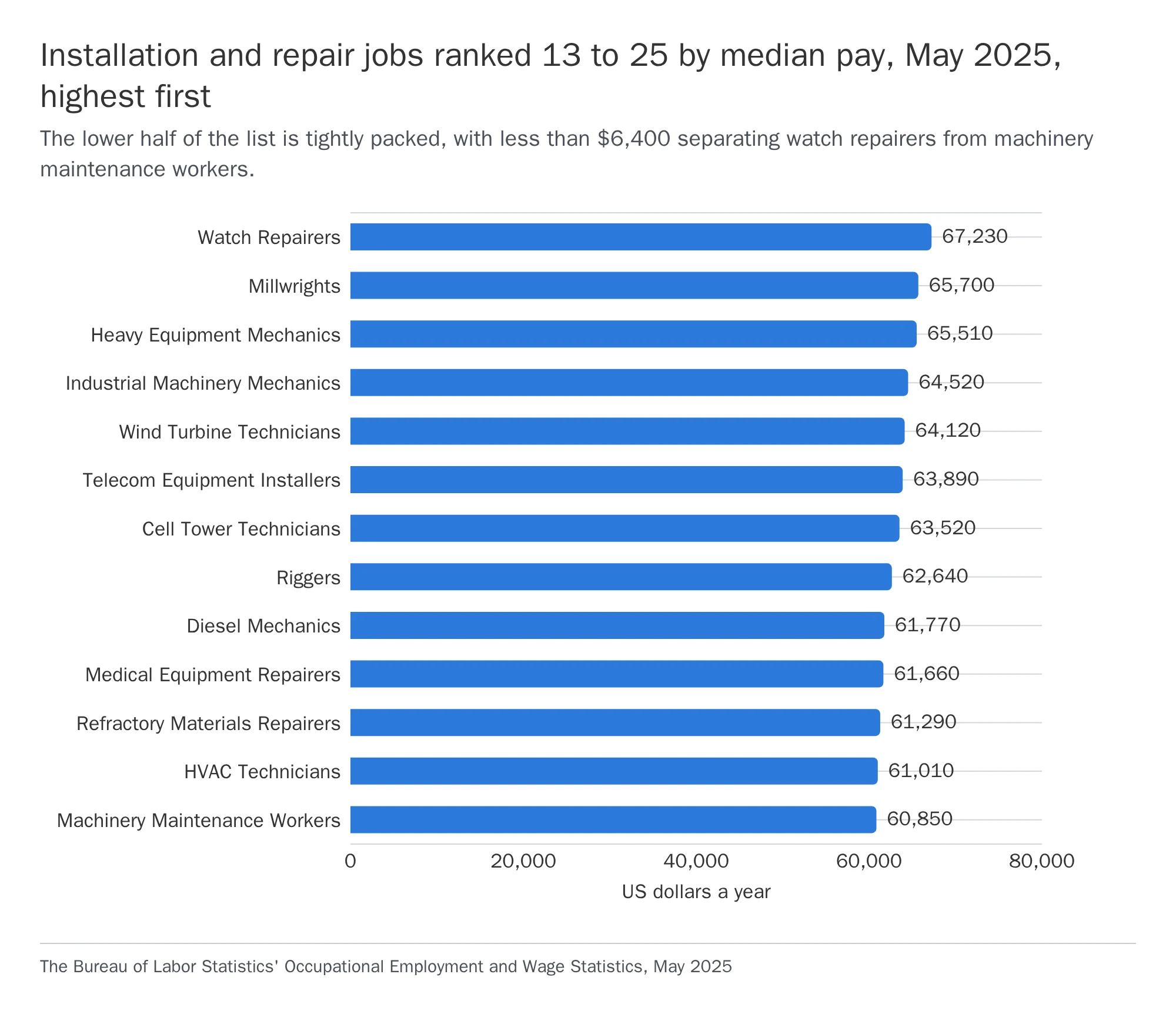
Security alarm installers came in 26th, with a median of $60,070 in May 2025. That is $780 below machinery maintenance workers, the 25th job. The gap is small, and it shows how tightly packed the bottom of the ranking is. Below that point, pay keeps falling: the lowest of the 49 qualifying jobs, tire technicians, earned $37,710.
What's Not in the Data
The figures are base pay only. BLS technical notes say the survey counts base rates, hazard pay, commissions and tips. It leaves out overtime, shift differentials and nonproduction bonuses. That matters for line workers, signal repairers and aircraft mechanics, who often work extra hours and storm or night shifts, so their real earnings can run well above these figures.
The survey also leaves out the self-employed, such as independent HVAC or watch repair shop owners. Annual figures assume a full-time year of 2,080 hours.
These are medians for the whole job, not starting pay. Half of workers earn more and half earn less, and new workers usually start near the bottom 10% figure. Workers are counted where their employer is located, not where they live. Jobs too small to meet the dataset's size floor do not appear in the ranking.
FAQs
What installation and repair job pays the most?
Powerhouse electrical repairers. They earned a median of $103,020 in May 2025, the only installation and repair job on the list above $100,000. They maintain and fix equipment in power plants, substations and relays.
How much do power line workers make?
$95,320 a year at the median, or $45.83 an hour, in May 2025. That ranks second on the list. The bottom 10% earned under $51,470, while the top 10% earned more than $128,690.
Do avionics technicians make more than aircraft mechanics?
Yes. Avionics technicians earned a median of $82,280 in May 2025, compared with $79,870 for aircraft mechanics. That is a gap of $2,410. Many avionics technicians work in aerospace manufacturing rather than at airlines.
How much do railroad signal repairers make?
$92,460 a year at the median in May 2025. That ranks third among installation and repair jobs. A 2022 emergency board recommended raises of 24% for 2020 through 2024 under national rail contracts, plus five annual $1,000 lump sums, per a U.S. Chamber fact sheet.
Which repair job has the most workers among the top earners?
Maintenance supervisors. The job had 617,500 workers in May 2025 and a median of $79,860, ranking seventh. Aircraft mechanics, with 138,090 workers, and power line workers, with 131,070, are the next-largest jobs in the top 10.
Does BLS pay data include overtime?
No. BLS wage figures count base pay, hazard pay and commissions but leave out overtime, shift differentials and nonproduction bonuses. Workers who log heavy overtime, such as line workers on storm duty, often earn more than the May 2025 medians show.
What will installation and repair jobs pay in 2026?
An estimated $106,842 for powerhouse electrical repairers, the top job. That 2026 figure is an estimate, not reported data. It applies a 3.71% wage growth index for installation and repair workers to the reported May 2025 median of $103,020.
How This List Was Built
The ranking uses median annual pay from the Bureau of Labor Statistics' Occupational Employment and Wage Statistics survey, May 2025. Each job had to meet a minimum size, keep the same job code across years, pass a national cross-check and a series check, and stay under a wage cap. A total of 49 installation, maintenance and repair jobs passed every rule, and the top 25 appear here. No job was left out by a data rule. The median of all 49 qualifying jobs is $60,850, and the median of the 25 jobs in the table is $67,230. The 2026 figures in the FAQs are estimates that multiply each May 2025 median by 1.0371, the change in BLS's wage index for installation, maintenance and repair workers from the second quarter of 2025 to the second quarter of 2026.