

From May 2016 to May 2025, Merchandise Displayers in Alabama saw median pay climb 91.4% — three times the typical job's 30.3% rise. The job paid $22,380 a year when the window opened. It paid $42,840 in May 2025, the latest month the survey covers.
The measure is median annual pay for each occupation, from the Bureau of Labor Statistics' survey of Alabama employers. Only jobs with at least 1,000 workers in both years are ranked, and only those whose federal job code and title did not change between them — 196 jobs in all. Lists built on different survey years will not match this one.
What nine years of Alabama pay data settles:
- 📈 91.4% — Merchandise Displayers, the fastest riser in the state
- 📞 78.4% — Telecom Line Installers, second, and nearly double the national 41.3%
- 🛡️ $20,100 to $33,720 — what Security Guards' median pay did across the window
- 📉 115 of 196 jobs lost ground to prices, even where the reported figure rose
- 🏆 7 of the 10 fastest-rising U.S. jobs are missing from Alabama's top 24
The 24 Alabama Jobs With the Fastest-Rising Pay
| Job | Median pay (May 2016) | Median pay (May 2025) | Change |
|---|---|---|---|
| Merchandise Displayers | $22,380 | $42,840 | 91.4% |
| Telecom Line Installers | $34,130 | $60,890 | 78.4% |
| Security Guards | $20,100 | $33,720 | 67.8% |
| Metal Extruding Machine Operators | $28,900 | $47,690 | 65.0% |
| Garbage Collectors | $28,240 | $46,240 | 63.7% |
| Veterinary Assistants | $22,340 | $35,800 | 60.3% |
| Freight Handlers | $22,950 | $36,670 | 59.8% |
| Sawing Machine Operators | $23,690 | $37,520 | 58.4% |
| Production Helpers | $22,780 | $35,910 | 57.6% |
| Licensed Practical Nurses | $36,180 | $57,030 | 57.6% |
| Dishwashers | $18,390 | $28,930 | 57.3% |
| Lifeguards | $18,060 | $28,130 | 55.8% |
| Tire Technicians | $22,500 | $35,010 | 55.6% |
| Landscapers | $22,930 | $35,630 | 55.4% |
| Restaurant Cooks | $20,740 | $32,180 | 55.2% |
| Telemarketers | $22,550 | $34,840 | 54.5% |
| Machine Tool Operators | $28,400 | $43,800 | 54.2% |
| Fast Food Cooks | $18,190 | $27,870 | 53.2% |
| Cashiers | $18,550 | $28,250 | 52.3% |
| Maintenance and Repair Helpers | $23,730 | $36,140 | 52.3% |
| Structural Metal Fabricators | $34,320 | $52,220 | 52.2% |
| Cafeteria Food Servers | $19,120 | $29,000 | 51.7% |
| Bakers | $22,610 | $34,030 | 50.5% |
| Forklift Operators | $30,010 | $44,880 | 49.6% |
Source: the Bureau of Labor Statistics' Occupational Employment and Wage Statistics, May 2016 and May 2025. Median annual pay means half of Alabama workers in the job earn more and half earn less.
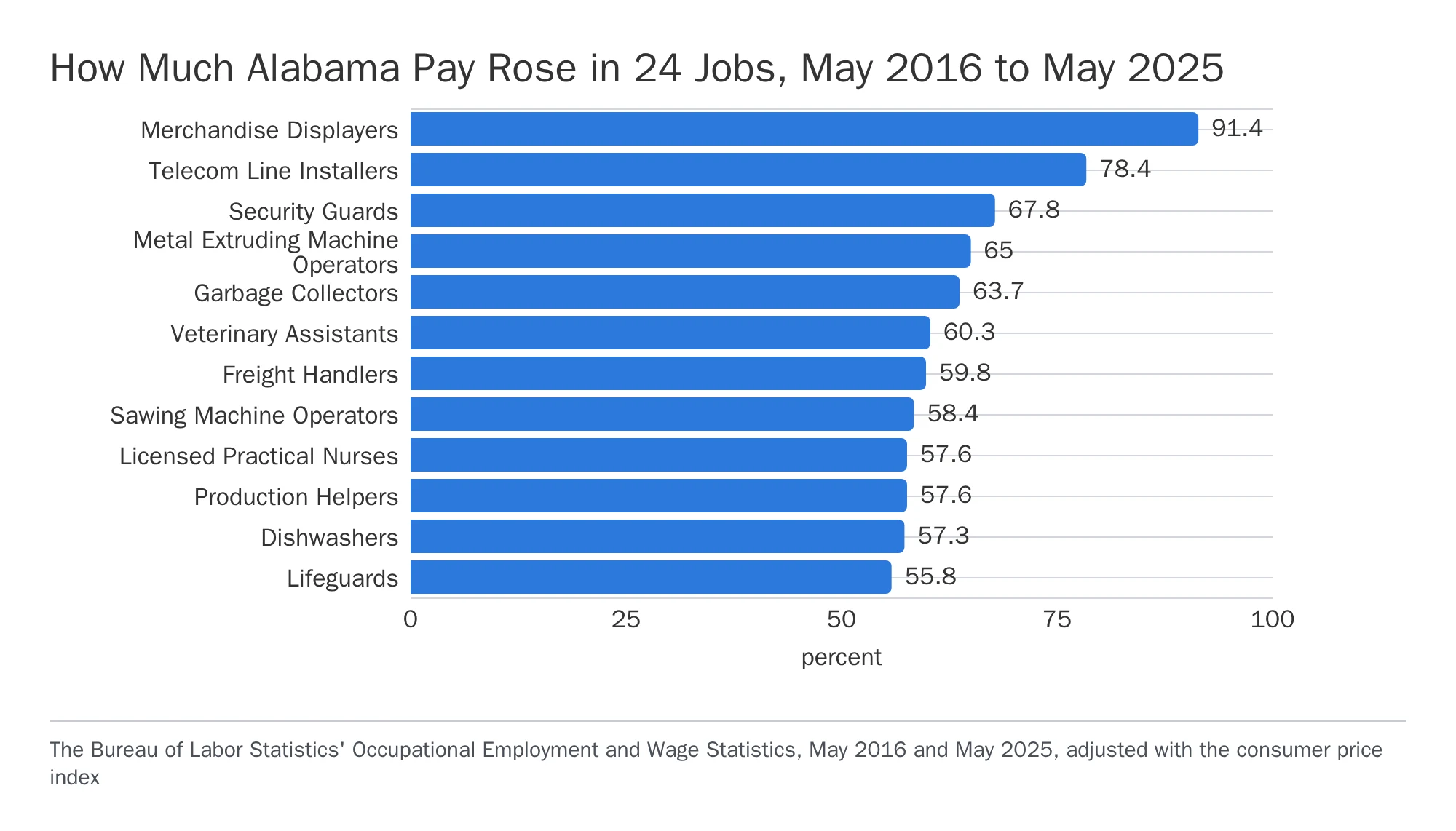
Merchandise Displayers Gained $20,460 a Year, the State's Largest Rise
Merchandise Displayers' median pay in Alabama went from $22,380 in May 2016 to $42,840 in May 2025, a rise of 91.4% and $20,460 a year. That is about $20.60 an hour, against $10.76 nine years earlier.
The starting figure shapes the percentage. At $22,380 a year, the job sat 168th of the 196 in starting pay, well down Alabama's scale, in a state whose wage floor is the federal $7.25 because it has no law of its own. Alabama counted 2,900 merchandise displayers in May 2025.
A 91.4% rise on $22,380 is $20,460 in the pocket; the same percentage on a $90,000 job would be $82,000. The two are not the same event, and this ranking measures the first kind.
A worker is counted at the employer's location, not at home, so displayers who dress Alabama stores land in Alabama's figures whatever address they drive from.
Nationally the same job gained 47.5%. Alabama's merchandise displayers beat the country by 43.9 points.
Telecom Line Installers Reached $60,890, the Top Pay in the Table
Telecom Line Installers rose 78.4%, from $34,130 to $60,890 — the only job in the 24 whose May 2025 median clears $60,000. It ranked 110th of 196 on starting pay and 65th on today's pay, a climb of 45 places within the same state ranking.
This is a small trade doing well. Alabama had 1,530 of these workers in May 2025, which puts the job 169th of 196 by headcount while sitting 2nd by pay growth. Where an employer pays extra for danger, the survey counts hazardous-duty pay inside the median rather than beside it.
The national comparison sharpens it. Across the country the same job rose 41.3%, ranking 130th of 482 U.S. occupations. Alabama's installers beat that by 37.1 points.
What the survey cannot say is whether the same people got the raise. It measures the job, not the worker, and a trade of 1,530 people can shift its median when a few hundred retire or a few hundred arrive.
Security Guards Rose 67.8% and Still Earn $33,720
Security Guards' median pay rose 67.8% — third fastest of the 196 Alabama jobs — and the job still ranks 166th of 196 on what it pays today, at $33,720. Back in May 2016 it ranked 179th at $20,100, or about $9.66 an hour.
Fifteen thousand two hundred and ten people in Alabama do this work, which makes it the 27th largest job in the state's data.
One likely contributor sits in the state's own workforce plan, which reports that older workers retiring are causing workforce shortages in Alabama's metropolitan areas. The plan does not name security guards, so the link to this job's 67.8% is not established here.
The $33,720 is the middle of the job's straight-time pay: half of Alabama's guards earned more than that in May 2025, and half earned less.
Metal Extruding Machine Operators Climbed 65% on 1,200 Jobs
Metal Extruding Machine Operators' pay rose 65%, from $28,900 in May 2016 to $47,690 in May 2025. The 2025 figure works out at about $22.93 an hour.
Metal extruding pushes heated metal or plastic through a die to make bar, tube and trim. That is factory work, and Alabama's Mercedes-Benz, Honda, Hyundai, Toyota and Mazda plants make motor vehicle manufacturing a major source of production jobs in the state. Alabama's workforce plan expects manufacturing to grow on the strength of announcements from major vehicle and equipment manufacturers — a likely contributor to what machine operators are paid, though the plan does not price the job itself.
Nationally the same job rose 40.9%, ranking 137th of 482 — Alabama beat the country by 24.1 points.
A 1,200-worker job is a thin sample, and a median built on it moves further on smaller changes than one built on the 46,420 cashiers.
Garbage Collectors Now Earn $46,240 After a 63.7% Rise
Garbage Collectors went from $28,240 to $46,240, a 63.7% rise that moved the job from 135th on Alabama pay to 105th. That is about $22.23 an hour, and 2,790 people in Alabama do it.
Collection routes run whether anyone applies or not, and they run at dawn in Alabama heat. The state's workforce plan ties its metropolitan labor shortages to retiring older workers — a likely contributor here, though the plan does not name this job. Nationally, refuse collectors rose 40.9%, 139th of 482 occupations; Alabama's 63.7% beats that by 22.8 points.
Alabama is a right-to-work state with among the lowest union membership rates in the country, so this rise happened in a labor market where few collection crews bargain collectively.
Where a crew earns a guaranteed day rate, the survey counts that pay as part of the wage.
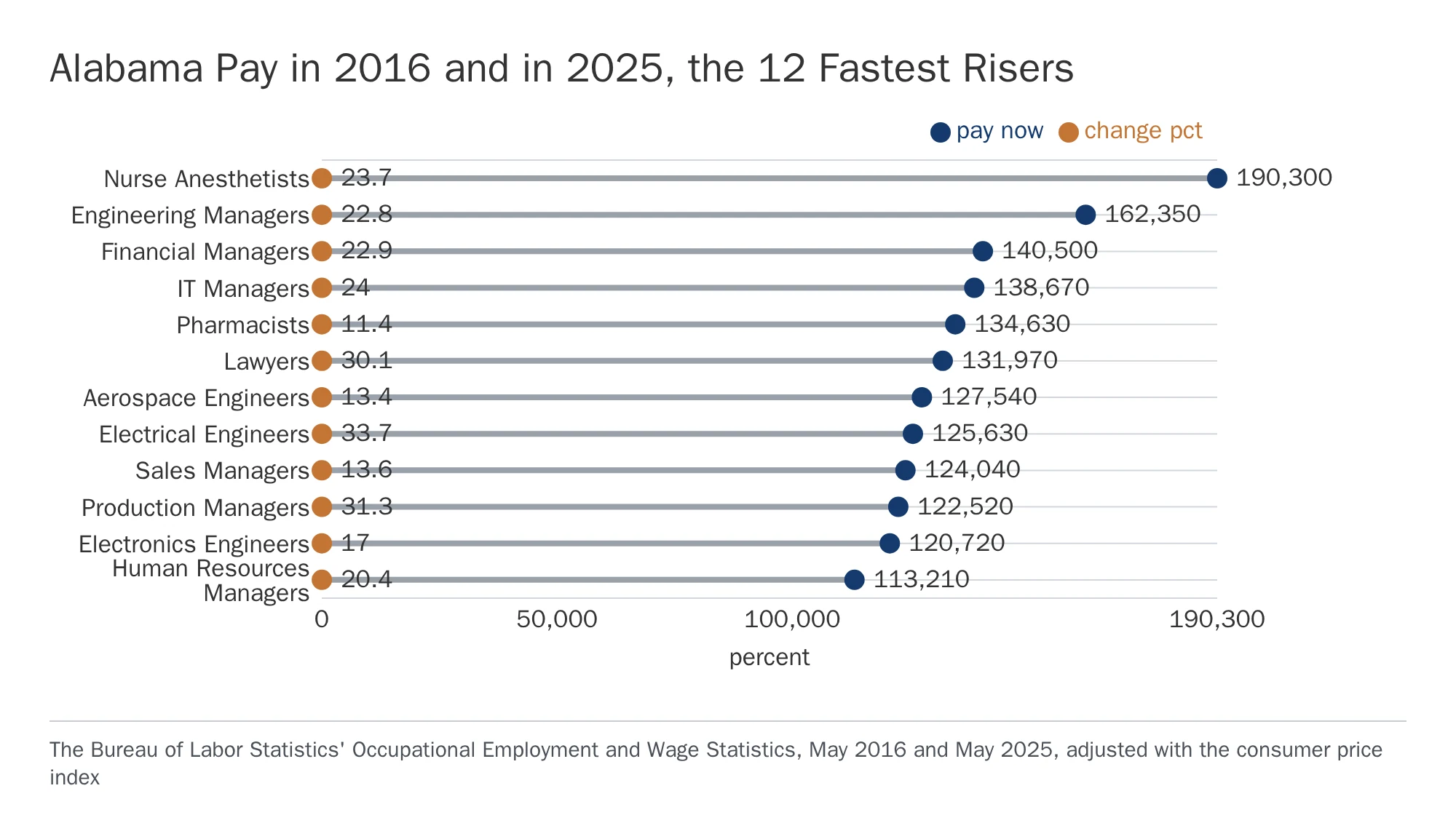
Pharmacists Rank 181st on Growth and 5th on Alabama Pay
Pharmacists' median pay in Alabama rose 11.4% between May 2016 and May 2025, from $120,880 to $134,630. No job among the 24 fastest risers earns near that: the best paid of them, Telecom Line Installers, reached $60,890.
A big percentage and a big paycheck are different things. Lifeguards, 12th in the table on growth, were paid $28,130 in May 2025 after a 55.8% rise. Alabama's lowest-paid jobs start very low: the state's wage floor is the federal $7.25, and a 2016 state law blocked Birmingham and other cities from setting anything higher. A job that begins near that floor can rise by half and still pay under $30,000.
A job's place on this list says nothing about whether it pays well. Merchandise Displayers, the fastest riser in the table, pay $42,840.
Pharmacists' 11.4% did not keep pace with prices: measured in today's dollars, the job's pay fell 16.8%.
115 of Alabama's 196 Jobs Lost Ground to Prices
115 of the 196 Alabama jobs — 59% of them — ended the window worth less than they started, even though almost all of them show a rise. Only 81 came out ahead.
A job whose reported pay did not keep up with prices lost ground. Electrical Engineers are the clean illustration: pay up 33.7%, from $93,940 to $125,630, which after inflation is a fall of 0.1%. Financial Advisors lost the most of the 196, down 9.5% in reported pay and 32.4% after prices.
Every one of the 24 jobs in the table cleared the price line. Merchandise Displayers gained 43% in real terms, the most in the state; Forklift Operators, last in the table at 49.6%, still gained 11.7%.
A job can therefore show a rise in both columns and still sit below the state's typical after-inflation change, which is a loss of 2.6%.
How Alabama Compares to the U.S.
Alabama's top two risers beat the nation by wide margins: Merchandise Displayers gained 91.4% here against 47.5% nationally, and Telecom Line Installers 78.4% against 41.3%. Nationally those jobs rank 80th and 130th of 482 occupations.
Nineteen of Alabama's 24 beat the national figure for the same job. The largest gaps sit in manufacturing and services: Metal Extruding Machine Operators by 24.1 points, Garbage Collectors by 22.8, Security Guards by 20.3, Machine Tool Operators by 16.8 and Structural Metal Fabricators by 16.2.
Five lag. Cafeteria Food Servers rose 51.7% in Alabama against 66.5% nationally, Cashiers 52.3% against 62.9%, and Dishwashers 57.3% against 67.4%.
Alabama's list is missing most of the country's fastest risers. Of the 10 jobs with the biggest wage growth nationally, only three appear in Alabama's 24 — Dishwashers, Cafeteria Food Servers and Lifeguards. Waiters, the national No. 1 at 76.2%, are not in Alabama's 24, and neither are Delivery Drivers and Sales Workers or Bussers. Four more — Airport Security Screeners, Locker Room Attendants, Bellhops and Ushers — have no Alabama figure at all.
What the Numbers Miss
The table shows what the middle of a job paid, on a straight-time, 2,080-hour year. It does not show how many hours anyone actually worked, and in Alabama that gap is large enough to change the story.
One Reddit poster, a nurse, said she pulled in $110,000 last year by working one extra shift a week. Another said a truck driver and a mine worker can both make a great deal of money at the cost of their time and health. None of that arithmetic is inside these figures: overtime, shift differentials, on-call pay, holiday premium pay and profit-sharing are all excluded, and so is the employer's cost of benefits.
Hours are not the only thing a pay figure leaves unsaid. Alabama has no state law setting minimum nurse-to-patient ratios in hospitals, so the $57,030 that Licensed Practical Nurses reached in May 2025 can buy an employer a very different night's work from one hospital to the next. The figure describes the middle of the pay scale, not the middle of the workload, and the survey was never built to carry the second.
What's Not in the Data
The survey counts wage and salary workers in nonfarm establishments. It leaves out the self-employed, owners and partners in unincorporated firms, household workers and unpaid family workers — so an Alabama landscaper with his own truck and clients appears nowhere in the 55.4% shown for landscapers.
Jobs below 1,000 Alabama workers in either year are not ranked; 292 smaller occupations were left out on that floor alone. So were jobs whose federal code or title changed between the 2010 and 2018 classifications — only 681 of 766 crosswalk matches carried through cleanly, and renamed, recoded, split and merged codes were dropped.
Crane and Tower Operators is absent for a different reason, given in the method note below.
Geography is by the employer's location, not the worker's: a Huntsville plant's payroll counts as Alabama even when the employee commutes from Tennessee. And the estimates pool six semiannual survey panels collected over three years, with older wages adjusted forward to the current May, so a single year's figure is not a snapshot of that month.
FAQs
Which Alabama job's pay rose fastest between May 2016 and May 2025?
Merchandise Displayers and Window Trimmers. Median pay rose 91.4%, from $22,380 to $42,840 a year — about $20.60 an hour on a 2,080-hour year.
How many Alabama jobs are in this comparison?
- Each needed at least 1,000 Alabama workers in both May 2016 and May 2025, and the same federal job code and title in both classifications.
Did any Alabama job's pay fall?
Yes. Two of the 196 fell in reported dollars: Personal Financial Advisors, down 9.5% to $77,990, and Instructional Coordinators, down 4.4% to $69,000.
How many Alabama jobs beat inflation?
81 of 196. The other 115 lost ground: prices rose 33.8% over the window, measured by the national consumer price index.
Which Alabama job pays the most in the top 24?
Telecom Line Installers, at a median $60,890 in May 2025 — roughly $29.28 an hour. It is the only job in the 24 above $60,000.
Does this pay include overtime?
No. The survey collects straight-time gross pay. Overtime, shift differentials, on-call pay, nonproduction bonuses and profit-sharing are all excluded; tips, commissions and hazard pay are included.
How does Alabama compare with the whole country?
19 of Alabama's 24 beat the national figure for the same job. Merchandise Displayers rose 91.4% here against 47.5% nationally, the widest gap in the table.
Which national fast risers are missing from Alabama's list?
Seven of the U.S. top 10. Waiters led the country at 76.2% and are not among Alabama's 24; nor are Delivery Drivers and Sales Workers, Bussers, Airport Security Screeners, Locker Room Attendants, Bellhops or Ushers.
What is Alabama's minimum wage?
$7.25 an hour, the federal rate. Alabama has no state minimum wage law, and a 2016 state law blocked cities such as Birmingham from setting a higher local wage.
Does a big percentage mean a big raise in dollars?
No. Security Guards' 67.8% is $13,620 a year, because the job started at $20,100. The percentage is measured against wherever the job began.
Are these figures for one worker over nine years?
No. Each is the median for the job in that May — half of Alabama's workers in it earned more, half less. The people in the job changed across the window.
How This List Was Built
The measure is median annual pay for each occupation in Alabama, from the Bureau of Labor Statistics' Occupational Employment and Wage Statistics for May 2016 and May 2025, with the change shown before and after inflation. Real changes use the national consumer price index for all urban consumers, which moved from 239.557 in May 2016 to 320.62 in May 2025, a factor of 1.338.
A job qualifies only with at least 1,000 Alabama workers in both years, which left out 292 smaller occupations, and only where its federal code and title are identical in the 2010 and 2018 classifications — 681 of 766 crosswalk matches. That leaves 196 ranked jobs; the table shows the top 24.
Left out as a likely data error: Crane and Tower Operators. Its pay jumped 27.7% in one year, from $47,620 in May 2024 to $60,790 in May 2025, 20.1% above any earlier year (the highest was $50,600 in May 2023), while the national figure for the same job moved 2.6%.
Before citing, check that a comparison job's code did not change between the two classifications.