

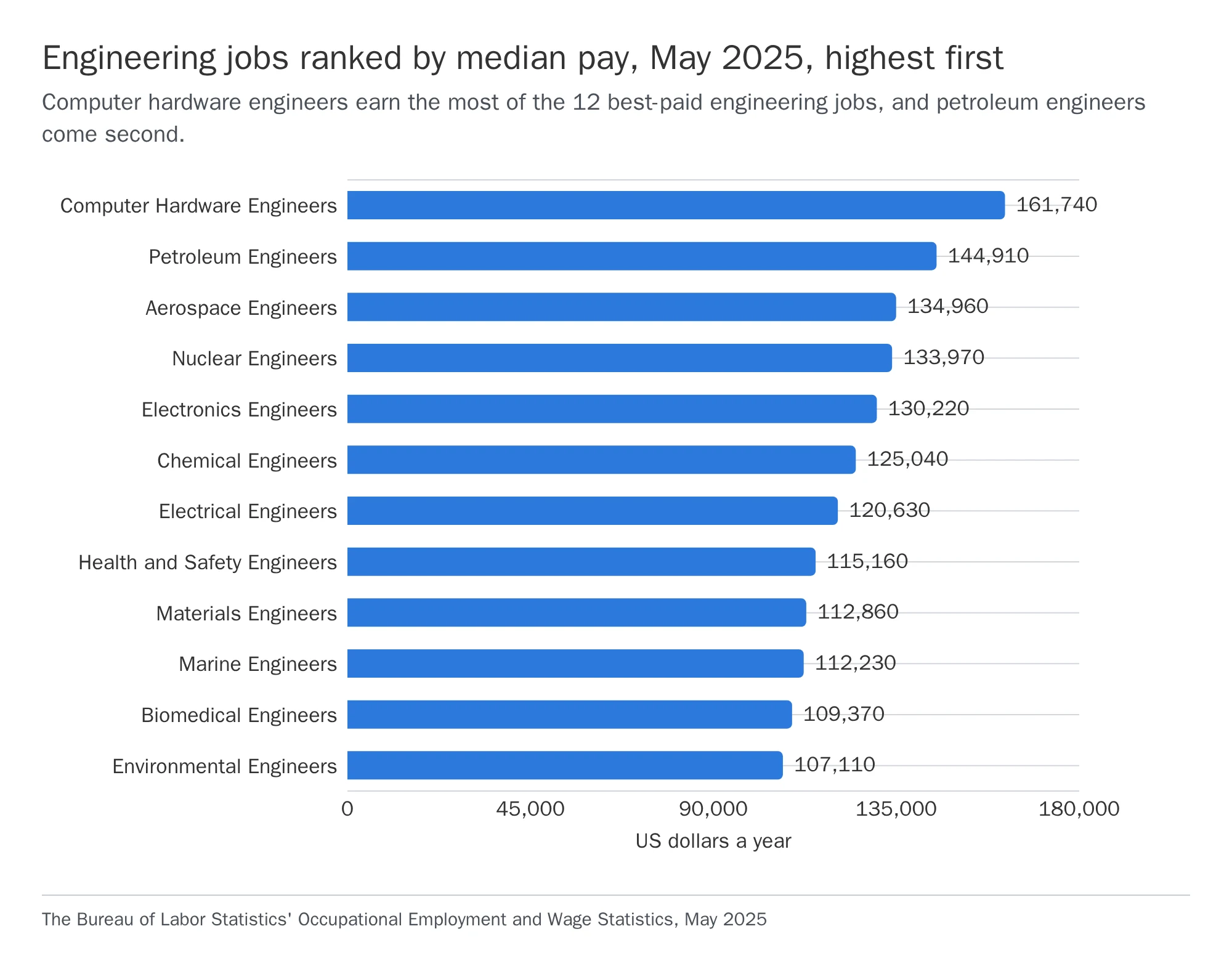
Computer hardware engineers are the highest-paid engineers in the country, with median pay of $161,740 in May 2025, compared with $112,860 for the typical job on this list. The top of the ranking belongs to engineers who work where money is concentrated: chip companies, oil producers, aerospace and defense firms, and nuclear plants and labs. Tight hiring in those industries, security clearance rules and a large federal payroll help keep pay high.
This ranking uses median annual pay from the Bureau of Labor Statistics' Occupational Employment and Wage Statistics (OEWS) survey for May 2025, the latest month published. Seventeen engineering occupations passed every data rule, including a minimum size and the same job code across the data, and all 17 appear below. This 2026 article rests on those latest published figures; the 2026 column is an estimate, not reported pay.
What the data shows:
- 💻 Computer hardware engineers lead at $161,740, which is $16,830 more than second-place petroleum engineers.
- 🛢️ Petroleum engineers have the widest pay range on the list: the top 10% earn more than $253,200.
- ⚛️ Nuclear engineers have the highest pay floor, with the lowest-paid 10% still earning at least $92,960.
- 🚀 Aerospace and nuclear engineers sit just $990 apart at ranks 3 and 4.
- 🏗️ Civil engineers are the largest group, with 367,840 jobs, yet they rank 16th at $100,840.
| # | Job | Median pay (May 2025) | Employment | Mean pay | Bottom 10% earn less than | Top 10% earn more than | Median pay, 2026 estimate |
|---|---|---|---|---|---|---|---|
| 1 | Computer Hardware Engineers | $161,740 | 76,660 | $162,670 | $92,940 | $225,330 | $167,449 |
| 2 | Petroleum Engineers | $144,910 | 18,060 | $157,150 | $81,440 | $253,200 | $150,025 |
| 3 | Aerospace Engineers | $134,960 | 67,710 | $142,060 | $86,700 | $205,890 | $139,724 |
| 4 | Nuclear Engineers | $133,970 | 15,280 | $140,420 | $92,960 | $196,290 | $138,699 |
| 5 | Electronics Engineers | $130,220 | 96,900 | $137,280 | $81,840 | $206,960 | $134,817 |
| 6 | Chemical Engineers | $125,040 | 21,070 | $129,980 | $79,420 | $182,880 | $129,454 |
| 7 | Electrical Engineers | $120,630 | 198,750 | $125,100 | $76,550 | $184,300 | $124,888 |
| 8 | Health and Safety Engineers | $115,160 | 21,450 | $119,770 | $68,420 | $171,250 | $119,225 |
| 9 | Materials Engineers | $112,860 | 22,770 | $120,250 | $72,300 | $175,720 | $116,844 |
| 10 | Marine Engineers | $112,230 | 8,250 | $124,180 | $83,010 | $173,330 | $116,192 |
| 11 | Biomedical Engineers | $109,370 | 23,480 | $116,890 | $71,850 | $168,180 | $113,231 |
| 12 | Environmental Engineers | $107,110 | 38,340 | $112,910 | $69,990 | $162,220 | $110,891 |
| 13 | Mining Engineers | $106,220 | 6,080 | $115,410 | $67,490 | $169,990 | $109,970 |
| 14 | Mechanical Engineers | $104,110 | 296,810 | $113,610 | $73,990 | $164,340 | $107,785 |
| 15 | Industrial Engineers | $102,440 | 365,740 | $109,900 | $74,370 | $159,860 | $106,056 |
| 16 | Civil Engineers | $100,840 | 367,840 | $108,670 | $68,240 | $163,220 | $104,400 |
| 17 | Agricultural Engineers | $98,590 | 1,480 | $108,230 | $68,060 | $166,460 | $102,070 |
Source: U.S. Bureau of Labor Statistics, Occupational Employment and Wage Statistics, May 2025. The 2026 column is an estimate: May 2025 pay multiplied by the change in the Employment Cost Index for professional workers' wages from the second quarter of 2025 to the second quarter of 2026.
Why Engineering Pays So Well
Engineering as a whole pays about twice what the typical American job pays. The BLS puts the median for all engineers at $108,620 in May 2025, against $50,980 for all occupations. Every job on this list starts with a bachelor's degree in engineering or a related field. That entry bar keeps the pool of candidates small.
A license is usually not what sets pay at the top. The BLS says licensure is not required for entry-level nuclear, aerospace, chemical and materials engineering jobs. The Professional Engineer (PE) license matters later, when an engineer signs off on projects or serves the public directly.
The bigger force is where each job sits. The best-paid engineers cluster in a few high-value industries: chip making, oil and gas extraction, aerospace and defense, and nuclear power and research. The federal government is also a large employer of the top five jobs, and it often pays at or above the occupation's median. The sections below show those links job by job.
1. Computer Hardware Engineers: $161,740
Computer hardware engineers earned a median of $161,740 in May 2025, or $77.76 an hour, according to the BLS hardware engineer profile. The survey counted 76,660 of them. They design and test processors, circuit boards and memory devices. They are not software developers, who are a separate occupation.
The job is tied to the chip industry. Semiconductor and electronic component makers employ 24% of hardware engineers, the largest share of any industry. Research and development firms employ another 18%, and the federal government employs 6%.
A tight supply of chip engineers is a likely contributor to the top ranking. In July 2023, the Semiconductor Industry Association and Oxford Economics projected a shortfall of 67,000 technicians, computer scientists and engineers in the U.S. chip industry by 2030. The group said 27,300 of those unfilled jobs would be in engineering and 26,400 in technician roles. That figure is a projection, not a count of current openings. The same study expected the industry's U.S. workforce to grow from about 345,000 jobs to about 460,000 by 2030, helped by the CHIPS and Science Act of 2022.
These causes explain why chip makers compete hard for hardware engineers. They do not explain the full $16,830 lead over petroleum engineers, and no source compares the two directly. The BLS expects employment in this job to grow 9% from 2025 to 2035, much faster than average.
2. Petroleum Engineers: $144,910
Petroleum engineers earned a median of $144,910 in May 2025, or $69.67 an hour, per the BLS petroleum engineer profile. The survey counted 18,060 of them. They plan how to drill wells and pull oil and gas from underground rock. They are not chemical engineers, who design refinery and plant processes.
The industry they work in explains most of their pay. Petroleum engineers at oil and gas extraction companies earned a median of $180,080 in May 2025. Those at support firms that drill and service wells on contract earned $126,600. Engineering services firms paid them $96,040.
Oil and gas extraction is one of the highest-paying U.S. industries, with a mean wage of $122,890 across all its jobs in May 2025. Petroleum engineers in that industry averaged $193,990. That high-paying core helps explain why the top 10% of petroleum engineers earn more than $253,200, the highest top-end pay on the list.
The industry tie also cuts the other way. Pay depends on which part of the oil business an engineer works in, and the gap between producers and contractors is wide. The BLS expects employment to grow just 2% from 2025 to 2035, slower than average.
3. Aerospace Engineers: $134,960
Aerospace engineers earned a median of $134,960 in May 2025, or $64.89 an hour, according to the BLS aerospace engineer profile. The survey counted 67,710 of them. They design and test aircraft, spacecraft, satellites and missiles.
Defense work shapes this job. The BLS says engineers on national defense projects may need a security clearance, and some clearance levels require U.S. citizenship. That rule shrinks the pool of eligible workers. Aerospace product makers employ 38% of these engineers, and the federal government employs 15%.
Hiring pressure in the industry helps explain the pay level. In a spring 2025 survey for the AIA and McKinsey workforce study, 88% of the more than 30 aerospace and defense companies surveyed said they had raised pay in the past year to attract critical talent. About eight in ten of the 25 companies answering that question said top candidates took other offers because of salary. Engineering was the hardest area to hire for, cited by 76% of companies.
The highest-paying setting for aerospace engineers is research and development, at a median of $149,260. The federal government paid $142,630, and aerospace manufacturers paid $137,030. The study's findings cover the whole industry, not aerospace engineers alone, so they show pressure on pay rather than a direct cause of this median.
4. Nuclear Engineers: $133,970
Nuclear engineers earned a median of $133,970 in May 2025, or $64.41 an hour, per the BLS nuclear engineer profile. The survey counted 15,280 of them. Their work is broader than reactor design. It includes naval propulsion, medical isotope production, nuclear batteries for spacecraft, and safety rules for power plants.
The job pays well at every level. Its lowest-paid 10% earn at least $92,960, the highest floor of any job on the list. Nuclear power plants employ 21% of nuclear engineers, research and development firms 20%, and the federal government 17%.
Hiring is hard in the nuclear field. The Department of Energy's 2025 energy jobs report found that more than 80% of employers in nuclear construction, manufacturing, utilities and other parts of the sector had at least some trouble hiring in 2024. In nuclear power generation, 63% of manufacturing employers called hiring "very difficult," more than in any other power sector. In the same report, nuclear jobs held three of the top five spots by median pay among power-generation jobs. Nuclear engineer led those three, at $127,520 in DOE's own survey.
Training rules add to the cost of each hire. At a plant, new engineers complete onsite safety training and retrain every year. Some earn a Senior Reactor Operator license from the Nuclear Regulatory Commission. Research pays most, with a median of $146,760, while the federal government pays $118,440. The BLS expects little or no change in employment from 2025 to 2035, so the high pay reflects scarce skills more than a growing workforce.
5. Electronics Engineers: $130,220
Electronics engineers, except computer, earned a median of $130,220 in May 2025, per the BLS electrical and electronics profile. The survey counted 96,900 of them. They design circuits and components for products such as radar, sonar and communications gear. Engineers who focus on computers fall under computer hardware engineers instead.
Chip and defense work lift this job's pay. Electronics engineers at semiconductor makers earned a median of $146,700, the highest of their main industries. The federal government, their largest employer at 15% of jobs, paid $135,890.
Not every setting pays that much. Telecommunications employs 14% of electronics engineers but paid a median of $109,040. The mix of high-paying chip and federal jobs helps explain why this occupation outranks electrical engineers.
The Other 12: What Keeps Their Pay High
- Electrical Engineers ($120,630): Aerospace manufacturers paid them a median of $141,160 in May 2025, and power utilities, which employ 10% of them, paid $122,430, per the BLS electrical engineer data.
- Materials Engineers ($112,860): Transportation equipment makers, their largest employer at 17% of jobs, paid a median of $125,190, and government paid $137,610, according to the BLS materials engineer profile.
No documented cause was found for Chemical Engineers, Health and Safety Engineers, Marine Engineers, Biomedical Engineers, Environmental Engineers, Mining Engineers, Mechanical Engineers, Industrial Engineers, Civil Engineers and Agricultural Engineers.
Just Missed the List
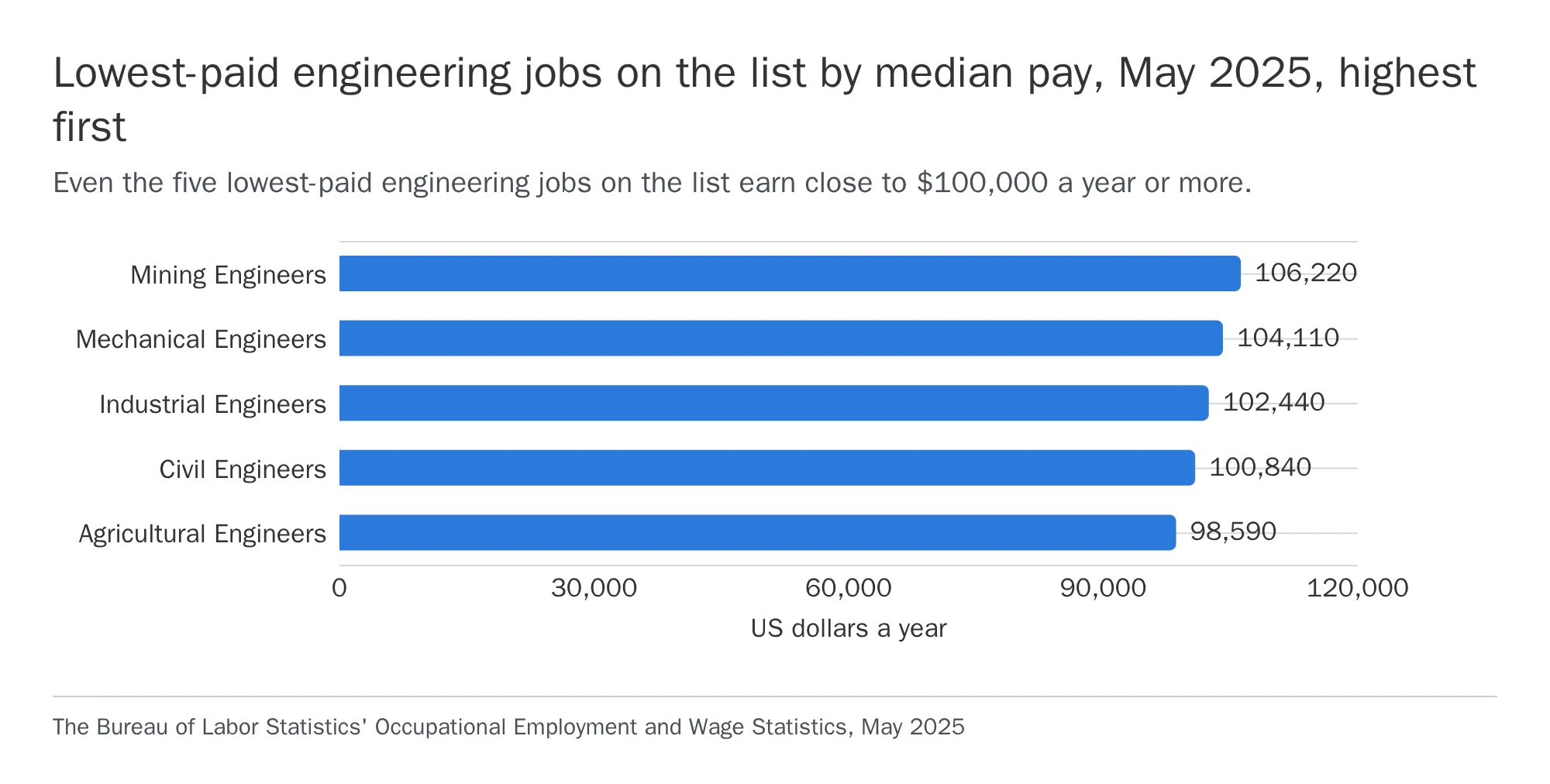
No engineering occupation missed this list. All 17 that passed the data rules are ranked here, so the cutoff falls at the last qualifying job. Agricultural engineers hold the 17th spot at $98,590, which is $2,250 below civil engineers. With just 1,480 jobs, they are also the smallest group on the list.
What's Not in the Data
BLS wage figures cover base pay, tips and commissions. They leave out overtime, shift pay, on-call pay and most bonuses, which can matter in oil and gas and at power plants. The survey does not count self-employed workers, so engineers who consult through their own firms are not included. Annual pay assumes a 2,080-hour work year. Each May estimate pools six survey panels collected over three years, and it counts workers where their employer is located.
FAQs
What is the highest-paying engineering job in 2026?
Computer hardware engineers. They earned a median of $161,740 in May 2025, the latest BLS figure. That is the top pay among the 17 engineering jobs ranked here, ahead of petroleum engineers at $144,910.
How much do petroleum engineers make?
$144,910 a year at the median in May 2025. The top 10% earned more than $253,200, the highest top-end pay of any engineering job. Those at oil and gas producers earned a median of $180,080.
Do petroleum engineers still make the most of any engineers?
No. In May 2025, computer hardware engineers earned a median of $161,740, which is $16,830 more than petroleum engineers. Petroleum engineers rank second on the list.
How much do aerospace engineers make?
$134,960 a year at the median in May 2025, or $64.89 an hour. Those in research and development earned a median of $149,260. Engineers on defense projects may need a security clearance.
How much do nuclear engineers make?
$133,970 a year at the median in May 2025. Even the lowest-paid 10% earned at least $92,960, the highest floor of any engineering job. Research and development firms paid the most, at a median of $146,760.
Do you need a PE license to get a high-paying engineering job?
No. The BLS says licensure is not required for entry-level jobs in fields such as nuclear, aerospace and chemical engineering. A Professional Engineer license matters later, for signing off on projects or serving the public directly.
What is the lowest-paying engineering job on the list?
Agricultural engineers, at $98,590 in May 2025. They are also the smallest group, with 1,480 jobs. Civil engineers rank just above them at $100,840.
What will engineers earn in 2026?
An estimated $102,070 to $167,449, from agricultural to computer hardware engineers. These 2026 figures are estimates. They apply the 2025-to-2026 rise in professional workers' wages to May 2025 pay, and they are not reported data.
How This List Was Built
The measure is median annual pay from the BLS Occupational Employment and Wage Statistics survey, May 2025, the latest release. Each row is one engineering occupation as BLS defines it. Rows had to meet a minimum employment size, keep the same occupation code, and pass a national cross-check, a series check, a wage cap and checks for implausible values. Seventeen occupations qualified, and all 17 are ranked. No row was excluded by any rule. The 2026 column is an estimate: each May 2025 median times 1.0353, the change in the Employment Cost Index for wages and salaries of civilian professional workers from the second quarter of 2025 (163.976) to the second quarter of 2026 (169.762).