

Roof Bolters earn the most of any mining job on this list, with median pay of $78,540 in May 2025, or $19,135 more than the typical job on the list at $59,405. Underground coal work holds two of the top four spots. It comes with strict federal training rules, a real risk of roof falls and a thin pool of experienced miners. Oil and gas rig jobs fill most of the middle of the ranking, and helper and entry jobs sit at the bottom.
This ranking uses median annual pay from the Bureau of Labor Statistics' Occupational Employment and Wage Statistics (OEWS) survey for May 2025, the latest month BLS has published. The 2026 article rests on those May 2025 figures. A job made the list only if it met the size floor and kept the same job code in the survey, and 12 mining and extraction jobs passed every rule. The 2026 figures in the FAQs are estimates: the May 2025 median raised by the growth in a BLS wage index for construction and extraction jobs, not reported pay.
What the data shows:
- ⛏️ Roof Bolters lead at $78,540, which is $4,040 more than Underground Mine Loading Operators at $74,500.
- 🛢️ Rotary Drill Operators have the highest top-end pay: their 90th percentile reaches $101,860.
- 💥 Blasters have the widest pay spread, $58,880 between the 10th and 90th percentiles.
- 👷 Roustabouts are the largest job, with 44,970 workers, and the lowest paid, at $46,960.
- 📉 The biggest gap in the ranking is between #9 Dragline Operators ($57,430) and #10 Rock Splitters ($48,740): $8,690.
| # | Job | Official BLS name | Median pay (annual), May 2025 | Mean pay (annual) | 10th percentile | 90th percentile | Employment |
|---|---|---|---|---|---|---|---|
| 1 | Roof Bolters | Roof Bolters, Mining | $78,540 | $78,100 | $63,750 | $92,830 | 2,160 |
| 2 | Underground Mine Loading Operators | Loading and Moving Machine Operators, Underground Mining | $74,500 | $71,240 | $52,030 | $87,730 | 5,930 |
| 3 | Rotary Drill Operators | Rotary Drill Operators, Oil and Gas | $67,890 | $72,130 | $47,010 | $101,860 | 12,600 |
| 4 | Continuous Mining Machine Operators | Continuous Mining Machine Operators | $61,810 | $65,050 | $46,770 | $86,210 | 14,000 |
| 5 | Blasters | Explosives Workers, Ordnance Handling Experts, and Blasters | $61,390 | $66,640 | $40,480 | $99,360 | 5,100 |
| 6 | Earth Drillers | Earth Drillers, Except Oil and Gas | $60,190 | $62,830 | $44,460 | $83,800 | 19,450 |
| 7 | Oil Derrick Operators | Derrick Operators, Oil and Gas | $58,620 | $60,210 | $43,380 | $81,800 | 10,590 |
| 8 | Oil Well Service Unit Operators | Service Unit Operators, Oil and Gas | $58,160 | $62,470 | $38,940 | $97,560 | 43,140 |
| 9 | Dragline Operators | Excavating and Loading Machine and Dragline Operators, Surface Mining | $57,430 | $59,930 | $41,600 | $82,400 | 34,480 |
| 10 | Rock Splitters | Rock Splitters, Quarry | $48,740 | $51,500 | $37,340 | $67,710 | 3,320 |
| 11 | Extraction Worker Helpers | Helpers–Extraction Workers | $47,730 | $50,620 | $36,960 | $68,020 | 6,700 |
| 12 | Roustabouts | Roustabouts, Oil and Gas | $46,960 | $49,200 | $36,420 | $64,530 | 44,970 |
Source: U.S. Bureau of Labor Statistics, Occupational Employment and Wage Statistics, May 2025. All figures are national.
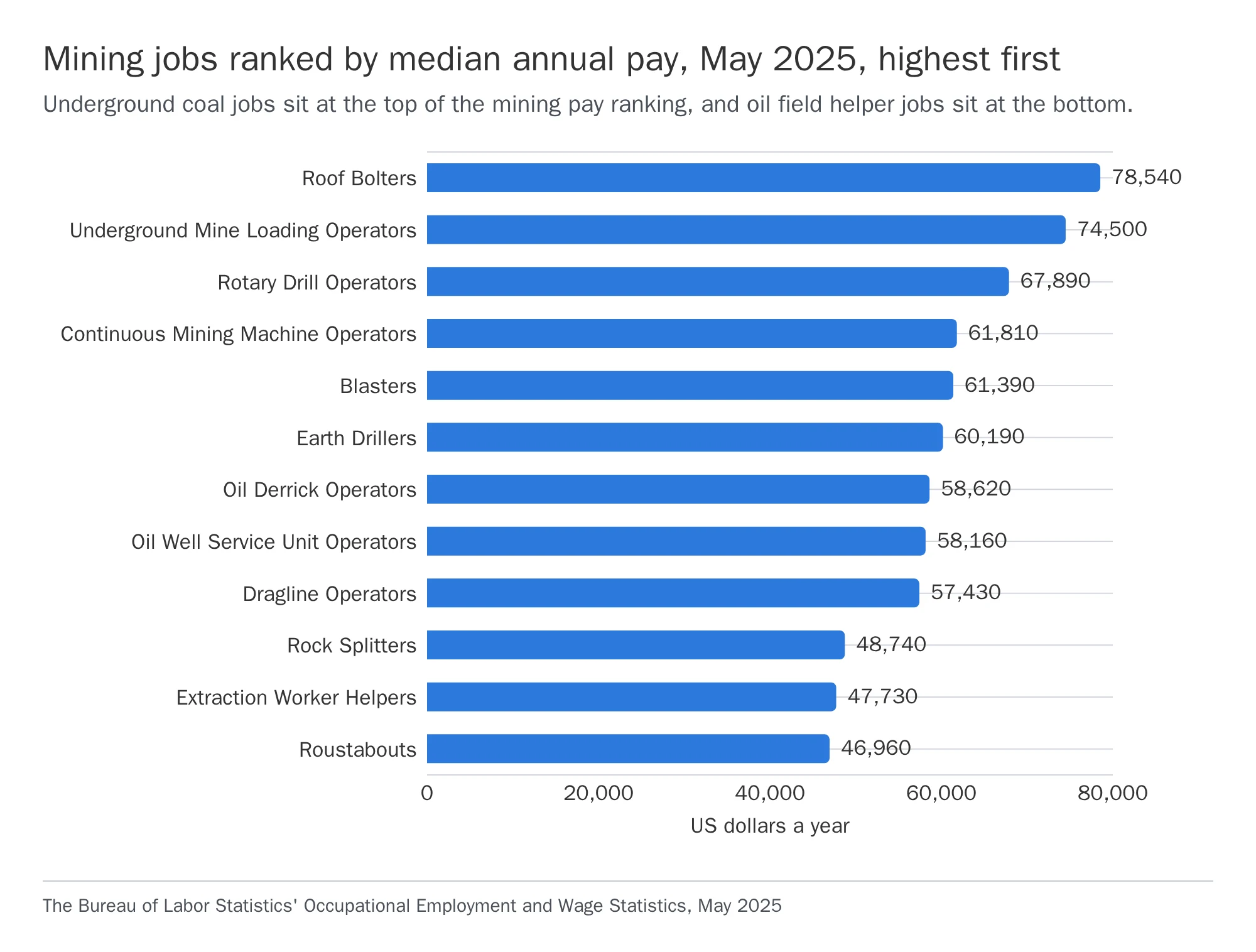
Why Mining Pay Sits Where It Does
Federal safety training sets a hard entry bar for underground work. Under the Mine Safety and Health Administration's Part 48 rules, new miners must get 40 hours of training before they work underground, compared with 24 hours for surface work. Every experienced miner also needs 8 hours of refresher training each year. That gap in training time helps explain why the three underground coal jobs on this list all pay more than the surface mining jobs.
Some states add their own rules on top of the federal ones. In West Virginia, a new underground coal miner must finish an 80-hour pre-employment program to get an apprentice card. A full miner's certificate then takes at least six months and 108 shifts as an apprentice, plus a passing score of 80% on a state exam. A worker can't just walk onto an underground crew, so trained miners are hard to replace.
The pool of trained coal miners has been thin. In May 2022, UMWA communications director Erin Bates told Ohio Valley ReSource there were "not that many experienced miners" wanting to come back to coal after being laid off. In February 2024, Blackhawk Mining CEO Jesse Parrish told the American Coal Council's Miami Coal Forum that his company had trained about 500 brand new coal miners in two years but still had "a very inexperienced workforce." Citing preliminary Labor Department data, Argus Media reported that the U.S. had 600 more coal mining jobs in December 2023 than a year earlier, and that miners' average weekly earnings rose. Both reports fall inside the survey's November 2022 to May 2025 window, so the shortage fits the timing of these pay levels.
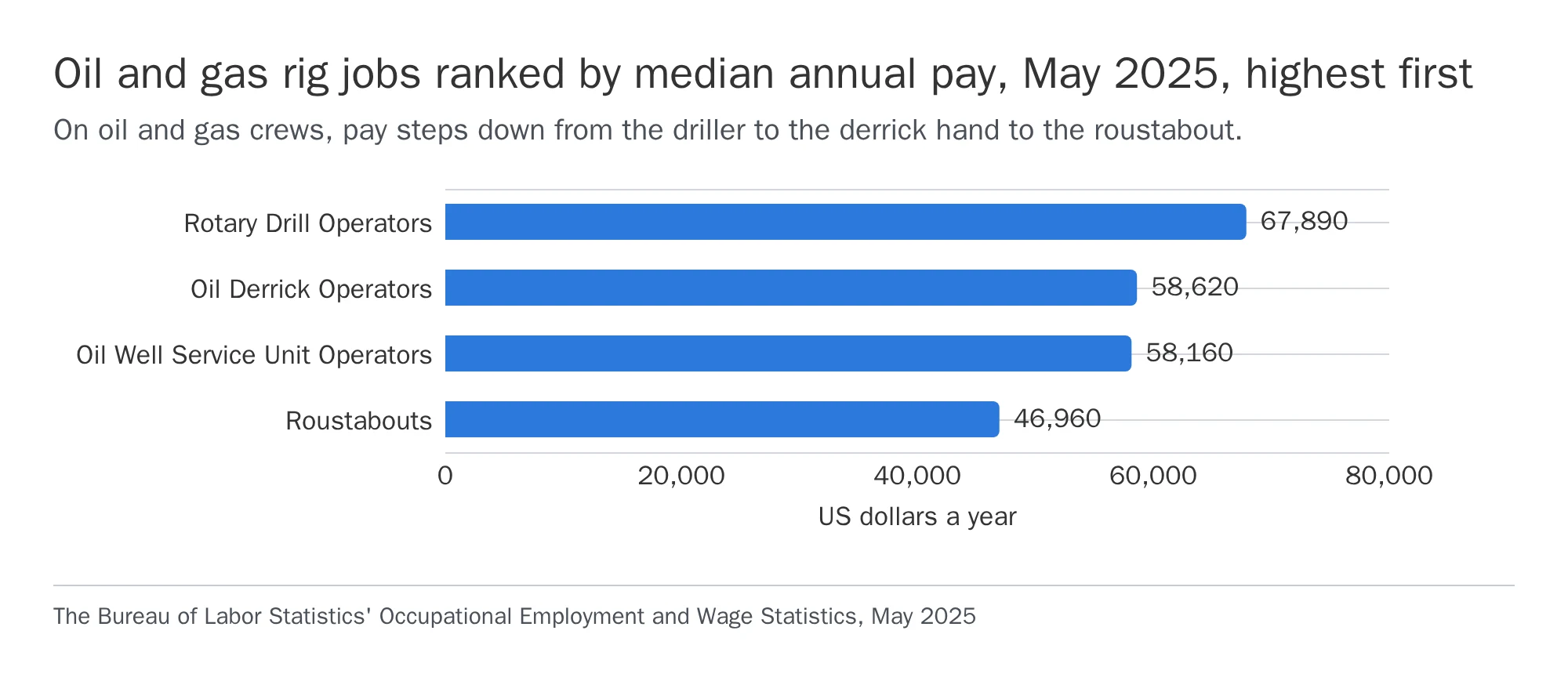
Oil and gas jobs follow a different set of rules. BLS says oil and gas workers learn on the job and usually need no formal education credential, and the group's median pay was $51,650 in May 2025. Pay climbs with rank on the rig crew, from roustabout up to driller. The work is also risky: OSHA reports that highway crashes are the leading cause of death for oil and gas extraction workers.
1. Roof Bolters: $78,540
Roof Bolters earned a median of $78,540 in May 2025, the most of any job on this list. Their mean pay was $78,100, and 2,160 people held the job, the smallest headcount in the ranking. Even the bottom 10% earned $63,750, which is above the typical job on the list. Few mining jobs pay this well at the low end.
A roof bolter runs the machine that drills into the mine roof and sets the bolts that keep it from falling. This is underground work, not surface drilling. MSHA requires every underground coal mine to follow a roof control plan approved by its district manager. The bolter is the worker who carries out that plan on the spot.
The job is also one of the most exposed in the mine. In 2012, 377 miners were hurt by roof and rib falls, and 145 of them were roof-bolter operators hurt by roof falls, according to MSHA. That risk is a likely contributor to the job's pay, along with the 40-hour federal training floor and the shortage of experienced coal miners. The 2012 count is older than the survey window, so it shows the nature of the hazard, not a recent change.
None of these causes explains on its own why bolters out-earn the other underground coal jobs. Loading operators and continuous miner operators face the same training rules and work in the same mines.
2. Underground Mine Loading Operators: $74,500
Underground Mine Loading Operators earned a median of $74,500 in May 2025, $4,040 less than Roof Bolters. Their mean pay was $71,240, and 5,930 people held the job. These workers run the machines that load and move coal or ore underground, such as shuttle cars and scoops. They are not haul truck drivers at open-pit mines, who fall under surface jobs.
The same Part 48 rule applies here: no new miner works underground without 40 hours of training. A loading operator also works close to the cutting face, where roof and rib hazards are greatest.
Big employers in metallurgical coal pay well above this median. Warrior Met Coal, which runs underground mines in Alabama and is hiring at its new Blue Creek mine, says on its careers page that its employees have "average earnings of $100K+" and rank in the top 10% of Alabama wage earners. That figure covers all of the company's workers and includes "performance-based incentives," so it does not match the BLS median, which leaves out nonproduction bonuses. It does show the pay level that large underground operators use to recruit.
The shortage of experienced miners helps explain this job's high floor: the bottom 10% earned $52,030. No source compares loading operators' pay with that of other underground jobs, so the $4,040 gap to Roof Bolters has no documented cause.
3. Rotary Drill Operators: $67,890
Rotary Drill Operators earned a median of $67,890 in May 2025, and 12,600 people held the job. Their 90th percentile was $101,860, the highest top-end pay on this list. These are oil and gas drillers. They are not petroleum engineers, and they are not the earth drillers who bore water wells or blast holes.
The driller runs the rig floor. BLS says rotary drill operators direct and monitor the work of derrick operators and roustabouts, on top of running the drill and keeping it repaired. That lead role helps explain why drillers earn more than the other oil and gas jobs on this list. BLS also notes that workers often move up the crew ladder through experience, since the field has no formal education path.
Schedules are another part of the reason. BLS says oil and gas schedules vary and may require workers to spend long periods away from home. The hazards are real: OSHA reports that three of every five on-site deaths in oil and gas extraction come from struck-by and caught-in hazards such as moving equipment and high-pressure lines.
The wide gap between the median and the 90th percentile likely reflects overtime-heavy rotations and offshore work, but no source documents that split. BLS medians also leave out overtime, so the top earners' real take-home pay is higher than the figures show.
4. Continuous Mining Machine Operators: $61,810
Continuous Mining Machine Operators earned a median of $61,810 in May 2025, and 14,000 people held the job. Their mean pay was $65,050. A continuous miner is the large machine that cuts coal from the face and loads it onto conveyors or shuttle cars. The job is underground, not surface excavation.
These operators face the same entry bar as other underground miners: 40 hours of federal training and, in West Virginia, an 80-hour state program followed by six months of apprenticeship. Running the machine well takes years on the job, and that is where the miner shortage bites hardest. In February 2024, Jesse Parrish said some producers were hesitant to start new mines or expand existing ones because they worried about hiring enough workers.
These causes explain why the job pays above surface mining work. They do not explain why it pays $12,690 less than Underground Mine Loading Operators in the same mines. The job is far larger than the two underground jobs above it, and that larger headcount may pull in more workers from lower-paying regions, but no source documents that.
5. Blasters: $61,390
Blasters earned a median of $61,390 in May 2025, just $420 behind Continuous Mining Machine Operators. Their mean pay was $66,640, and 5,100 people held the job. The BLS group also includes explosives workers and ordnance handling experts, so not every worker counted here is at a mine or quarry.
Blasting requires a stack of licenses. Under the federal Safe Explosives Act, ATF permits or licenses became required for all explosives users by May 24, 2003, and every blaster must clear an ATF background check as an "employee possessor." States add their own licenses. Pennsylvania requires a state blaster's license for anyone who sets off explosives or supervises blasting, with a minimum age of 21, ATF clearance and a passing exam. The license must be renewed every three years.
On federal surface coal permits, the Office of Surface Mining Reclamation and Enforcement issues its own blaster certificate, which also requires training, experience and an exam. These hurdles limit who can do the work, which helps explain the job's pay.
Blasters also have the widest pay spread on this list, $58,880 between the 10th and 90th percentiles. The mixed job group, which runs from helpers to licensed blasters and ordnance experts, is part of the reason, but no source breaks the spread down.
The Other 7: What Sets Their Pay
- Earth Drillers, $60,190: States license water well drilling, and Texas requires a license to drill a water-related well, which limits who can run the rig.
- Oil Derrick Operators, $58,620: Derrick operators set up and run the derrick and watch the mud pumps, and they work under the driller's direction, one step below on the crew ladder.
- Roustabouts, $46,960: Roustabouts assemble and repair oilfield equipment and clean rigs, and BLS says oil and gas workers need no formal educational credential, which fits the bottom rung of crew pay.
No documented cause was found for Oil Well Service Unit Operators ($58,160), Dragline Operators ($57,430), Rock Splitters ($48,740) and Extraction Worker Helpers ($47,730).
Just Missed the List
All 12 mining jobs that met the size and job-code rules made the list, so no job sits just below the cutoff. The closest race is at the bottom of the ranking. Roustabouts, at $46,960, trail Extraction Worker Helpers by $770, and Extraction Worker Helpers trail Rock Splitters by $1,010.
What's Not in the Data
BLS wage figures include tips and commissions but leave out overtime, shift differentials, on-call pay and nonproduction bonuses. That matters in mining, where long shifts and production bonuses are common, so many miners take home more than these medians. The figures also leave out the self-employed, which affects small drilling and blasting contractors.
The May 2025 estimates pool six survey panels collected over three years, from November 2022 to May 2025. A pay change that took effect in early 2025 shows up only in part. BLS turns hourly rates into annual pay by assuming a 2,080-hour work year, and it counts workers where their employer is, not where they live. All figures here are national medians, so they hide large gaps between coal states, oil states and quarry regions.
FAQs
What is the highest-paying mining job?
Roof Bolters. They earned a median of $78,540 in May 2025, the top figure among 12 mining and extraction jobs. Their bottom 10% earned $63,750.
How much do roof bolters make?
$78,540 a year (median, May 2025). Mean pay was $78,100. The top 10% earned $92,830 or more, and the bottom 10% earned $63,750 or less.
How much do oil rig drillers make?
$67,890 a year (median, May 2025). That is the BLS figure for Rotary Drill Operators, Oil and Gas. Their top 10% earned $101,860 or more, the highest top-end pay on this list.
Do underground miners earn more than surface miners?
Yes. In May 2025, the underground jobs on this list ranged from $61,810 to $78,540. Dragline Operators, the main surface mining job here, earned $57,430. Underground work requires 40 hours of federal training, against 24 hours for surface work.
What is the lowest-paying mining job on the list?
Roustabouts. They earned a median of $46,960 in May 2025. They are also the largest job on the list, with 44,970 workers.
Do you need a license to be a blaster?
Yes. Every blaster needs ATF clearance as an employee possessor of explosives, and states such as Pennsylvania require a state blaster's license. Blasters earned a median of $61,390 in May 2025.
How much will roof bolters make in 2026?
About $81,619, an estimate. That is the May 2025 median of $78,540 raised by the growth in a BLS wage index for construction and extraction jobs through mid-2026. It is not reported pay.
How This List Was Built
The ranking uses median annual pay from the BLS Occupational Employment and Wage Statistics survey for May 2025, the latest published month. Jobs qualified only if they met the size floor and kept the same job code, and they also passed a national cross-check, a series check, a wage cap and checks for implausible values. Twelve mining and extraction jobs passed every rule, and no job was left out by the data rules. The 2026 figure in the FAQs multiplies the May 2025 median by 1.0392, the growth from the second quarter of 2025 to the second quarter of 2026 in the BLS wage and salary index for construction, extraction, farming, fishing and forestry jobs.